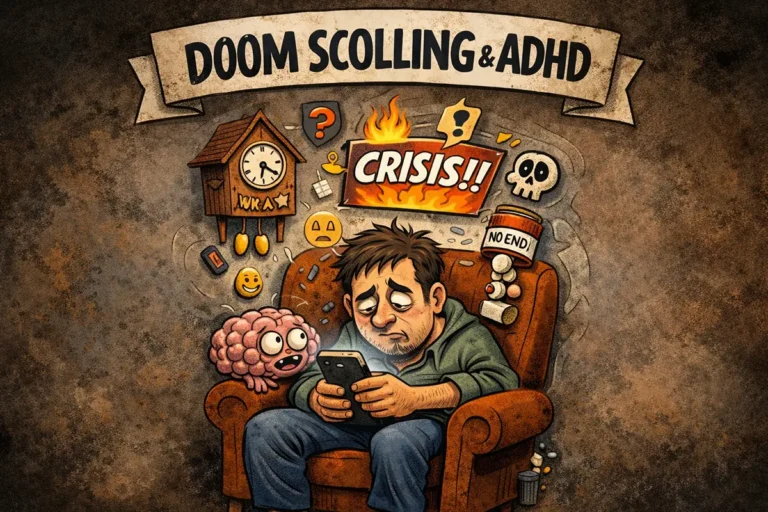
Doom Scrolling and ADHD
You check your phone for one thing.
The next thing you know, it’s dark outside and you’re emotionally invested in a situation that does not involve you, written by someone whose profile picture is a pickup truck.
If you have ADHD, this isn’t a discipline problem.
It’s what happens when a novelty-hungry brain collides with infinite scroll, which—purely coincidentally—was engineered to keep you trapped like a polite hostage.
I have to admit, I am a doom scroller! I can get on my phone and scroll for hours at a time. This stuff fascinates me. It also ruins my relationship and styfles my productivity. Not a good thing!
ADHD brains run low on steady dopamine, the chemical that makes normal life feel… tolerable. So they chase the exciting kind: novelty, urgency, emotion. Doom scrolling offers all three, in unlimited quantities, with no effort required.
That’s not a weakness. That’s efficiency.
And infinite scroll? That’s the real villain. ADHD brains rely on external endings. Pages. Episodes. Clear “we’re done now” signals. Infinite scroll removed all of them, like a magician who made the exit disappear.
So your brain concludes, reasonably:
“If there’s more, we’re supposed to keep going.”
Then there’s the content itself. Doom scrolling isn’t just scrolling—it’s threat consumption. Fear and outrage activate the brain’s alert system. For ADHD brains, that spike in anxiety can actually improve focus.
Which means your nervous system learns a terrible lesson:
“This feels awful, but I can finally concentrate.”
Congratulations. You’ve unlocked anxiety-based attention, the least relaxing feature ever invented.
The important thing to understand is this: doom scrolling isn’t about bad choices. It’s about a brain doing exactly what it evolved to do—seek stimulation and monitor threat—inside an environment designed to exploit both.
You don’t fix that with shame.
You fix it by changing the environment so your brain has somewhere to stop.
What actually helps
- Stop asking yourself to “scroll less.” Start asking where the ending is.
- Expect novelty-seeking and plan for it instead of pretending you won’t.
- Add external stopping cues—timers, friction, distance—because internal brakes are decorative at best.
Your brain isn’t broken.
It’s just operating in a system with no exits.
*Disclaimer: Offline.now offers educational coaching tips, not medical or therapeutic advice; please consult a qualified health professional for personal, clinical or health concerns.*
Blog post by Dr. Jeff Levine. He is an ADHD coach with a PhD in Organized Leadership.