Struggling with ADHD and Screen Time?

Welcome to Offline.Now! (Yes, we know we’re online.) Our goal is to help you understand your needs. Learn specific tips for ADHD to create digital balance.

No judgment. No spam. Just practical guidance, instantly.

Offline.now Self-Assessment

Question 1 of 2
Low
High
Question 2 of 2
Low
High
*By clicking send, you agree to our Privacy Policy and Terms of Use.

Find your Digital Balance

Welcome to Offline.Now - your place to create a healthy relationship with screens. We're here to actually make digital balance possible.
As an ADHD coach, I see it constantly: attention in ADHD isn't broken, it's interest-based. Screens are simply efficient dopamine delivery, meeting a need that's already there. Here's a clearer way to understand hyperfocus, and how to work with your wiring instead of against it in a world built to capture it.
If you keep switching between email, Slack, and social media yet feel like nothing gets done, you may be experiencing task-switching debt. For ADHD brains, every unfinished task creates cognitive tension that quietly pulls attention back again and again. This post explains how switching debt builds throughout the day and shares simple micro-experiments to reduce open loops, lower mental fatigue, and make it easier to return to the work that actually matters.

When your phone is your business, “just put it away” isn’t realistic. But constant access can quietly destroy focus—especially for ADHD brains wired for novelty. In this personal reflection, an ADHD coach shares how late-night and early-morning doom scrolling was hijacking his attention and nervous system, and how one surprisingly simple change—a smart watch alarm—created friction that protected his focus without disconnecting him from work.
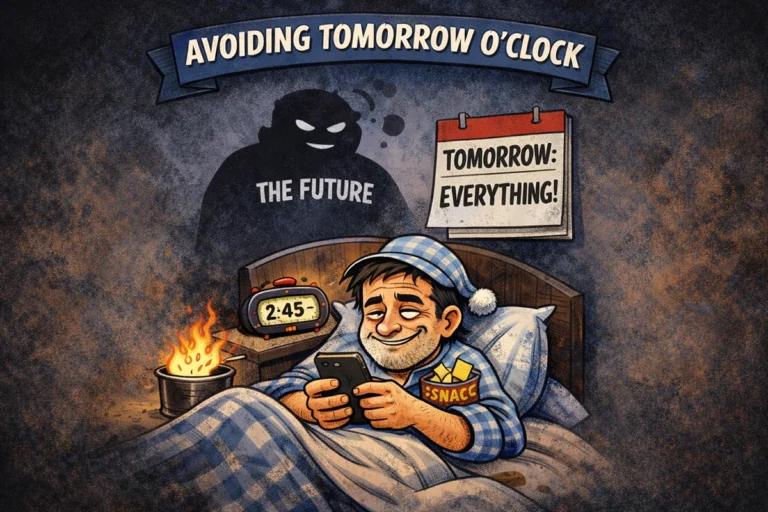
Late-night doom scrolling isn’t really about the phone—it’s about exhaustion, unfinished tasks, and an ADHD brain searching for relief. When the day feels overwhelming and nothing feels complete, endless scrolling offers easy stimulation without expectations. This post explores why burnout and ADHD make nighttime scrolling so common, and how small daytime shifts—like visible task completion and planned endings—can help your brain finally power down instead of staying stuck in the scroll.