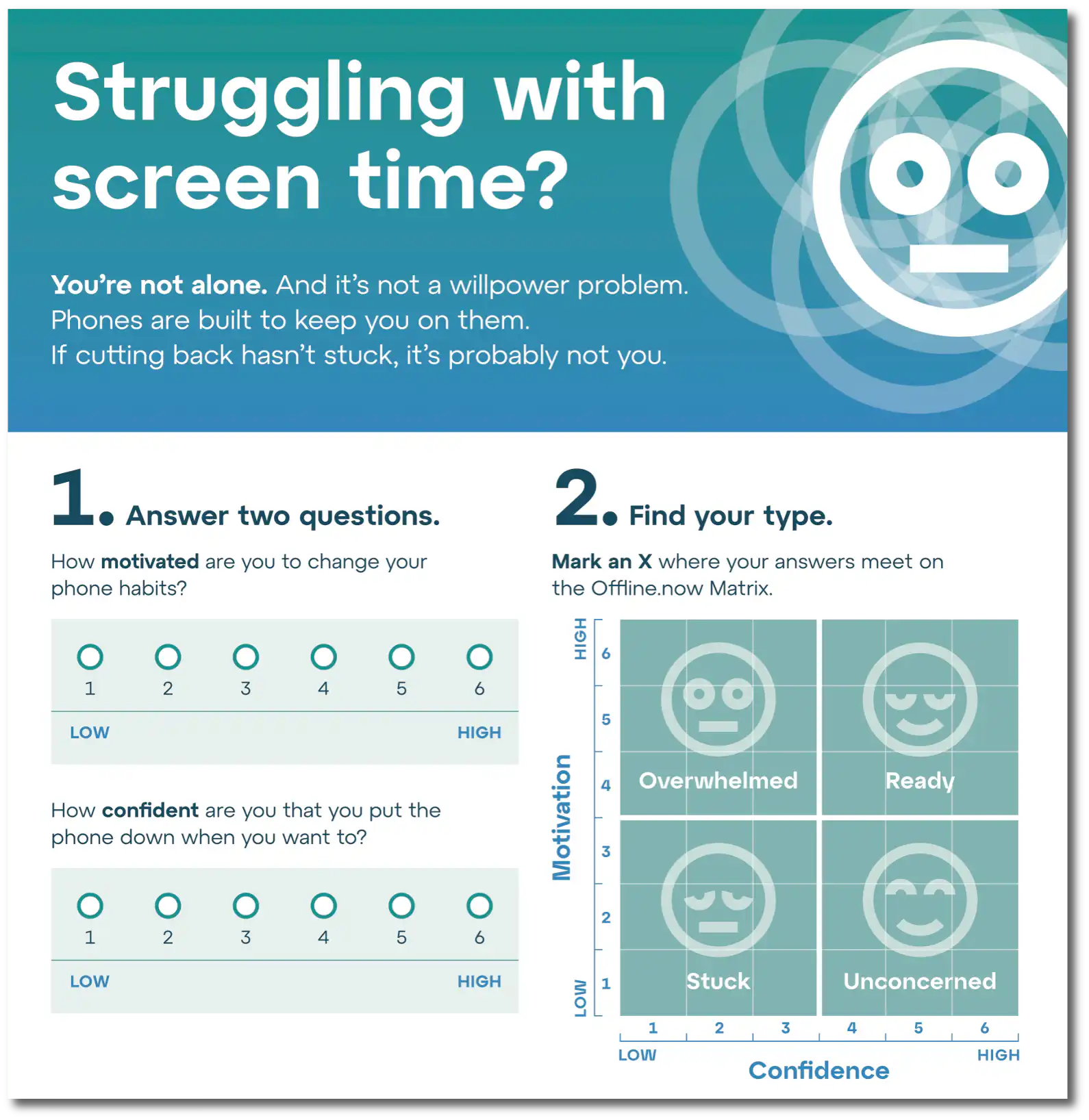
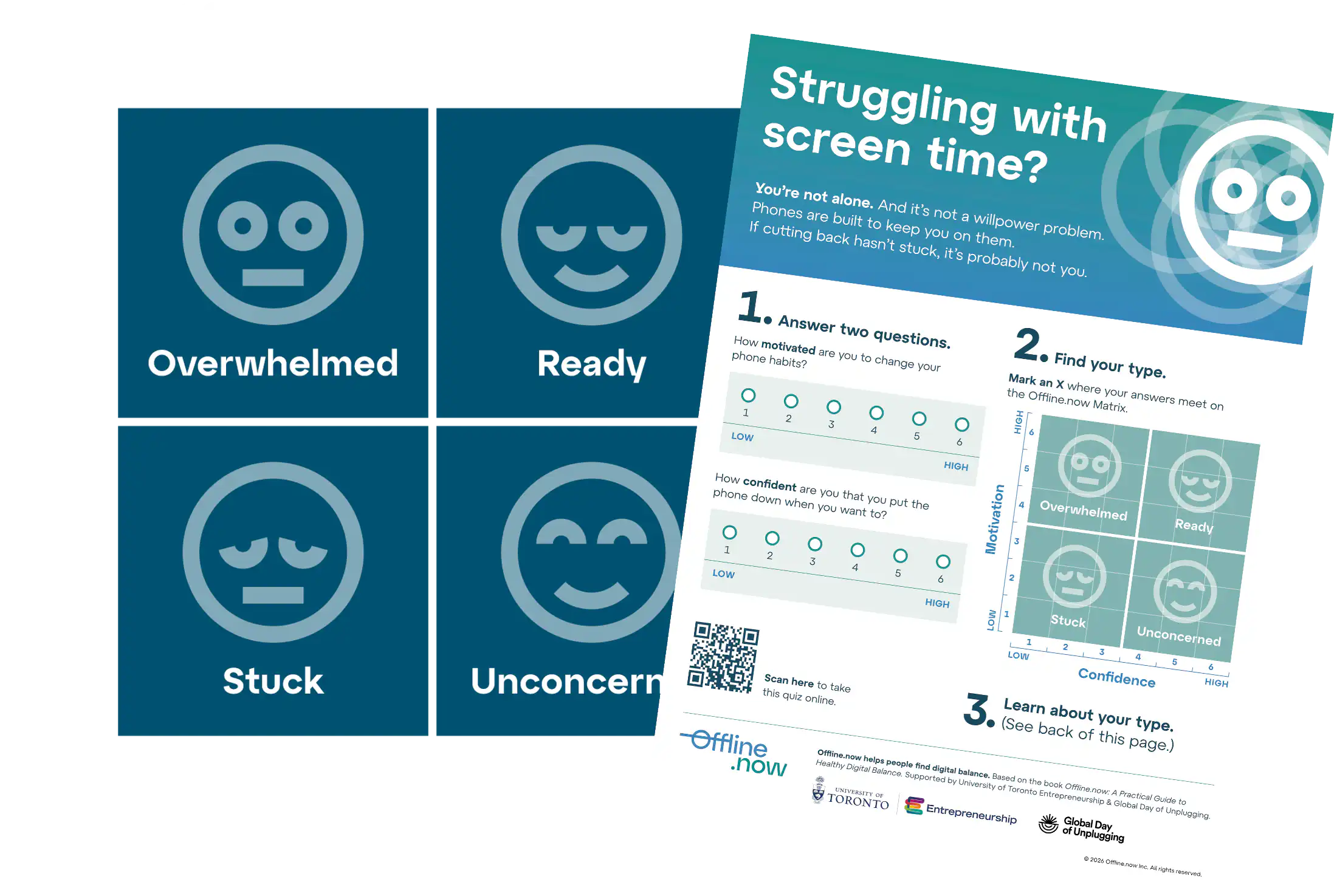
The free Find Your Starting Place worksheet

Two questions. Four starting places. One printable first step.

Download it, print it, or use it with a family, class, client, team, or community group.

No email needed to download.

Built for libraries, workplaces and schools

Toronto Public Library
Halifax Public Library
Waterloo Public Library
Kitchener Public Library
St. Catherines Public Library

How it works

The worksheet is the paper version of the Offline.now Matrix. Answer two questions about motivation and confidence, find your starting place, and choose one small first step. Take the quiz online for a personalized result, or print the worksheet and use it on paper.

Use it in your community

The worksheet is free to share. Use it as a conversation starter, a workshop handout, or a simple first step for people who want a healthier relationship with screens.

Libraries

Offer it on shelves, in branch programs, or as part of digital-wellbeing displays. Co-branded versions may be available.

Schools

Give students and families a shame-free starting point for screen-habit conversations.

Workplaces

Add it to wellness programming as a practical, low-pressure first step teams can actually use.
Offline.now A Practical Guide to Healthy Digital Balance

Go deeper into the Matrix

The quiz and worksheet help you find your starting place. The book takes you further, with type-specific guidance for changing screen habits in a way that feels practical and doable.

Available at
Available at Amazon

Digital balance is an ongoing conversation

Read stories, ideas, and practical guidance from the Offline.now community.

“What's your attachment style?” became a third-date question, but the dating-app version gets one thing backwards. Your attachment style isn't a fixed personality trait you were born with — it's a pattern you learned, and often one you inherited. Here's where it really comes from and how it can change.
As an ADHD coach, I see it constantly: attention in ADHD isn't broken, it's interest-based. Screens are simply efficient dopamine delivery, meeting a need that's already there. Here's a clearer way to understand hyperfocus, and how to work with your wiring instead of against it in a world built to capture it.
“Generational trauma” gets thrown around on TikTok for everything, but the real thing is far more useful than the watered-down version. Here's what intergenerational trauma actually is, how it passes between generations, the signs you might be carrying it, and why you can be the one it stops with.
Offline.now has been named Canadian Ambassador for the Global Day of Unplugging, the international movement for healthier screen habits across 20+ countries. We're holding space open for Canadian practitioners, organizations, and community partners to come together year-round on digital wellness. Come help us build it.
You meant to check one thing on your phone. That was forty-five minutes ago. Join Offline.now and the University of Toronto for Screen Life, a free Toronto Tech Week workshop on Thursday, May 28. Take a personal assessment, hear from a curated group of expert practitioners, and leave with a plan that fits your real life.
The debate about smartphones and mental health swings between alarm and dismissal. Both miss the real finding. The research is consistent on one thing: the phone is not the variable that matters. The pattern of use is. Here is what that distinction actually means - and how to use it to think more clearly about your own habits.