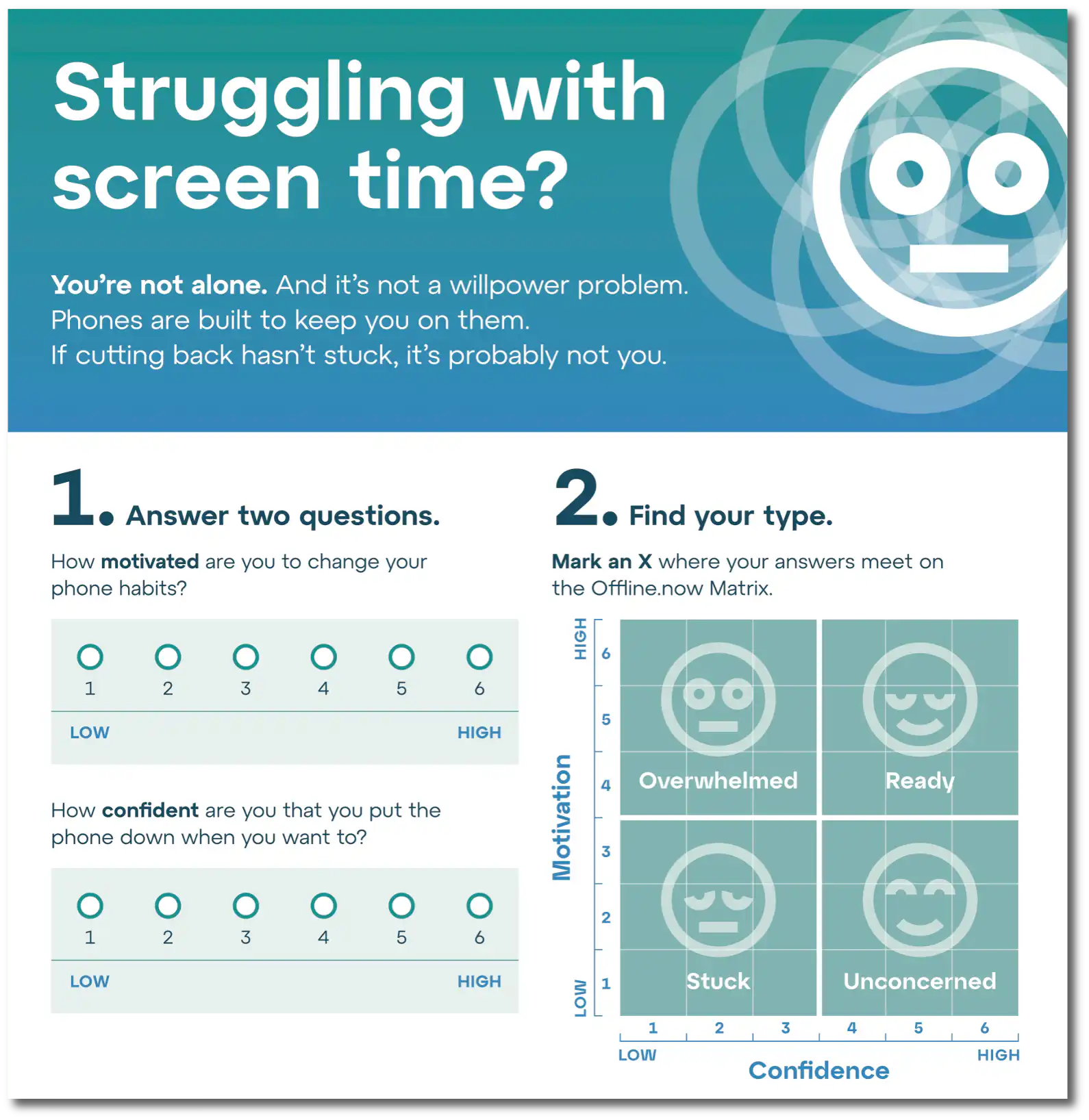
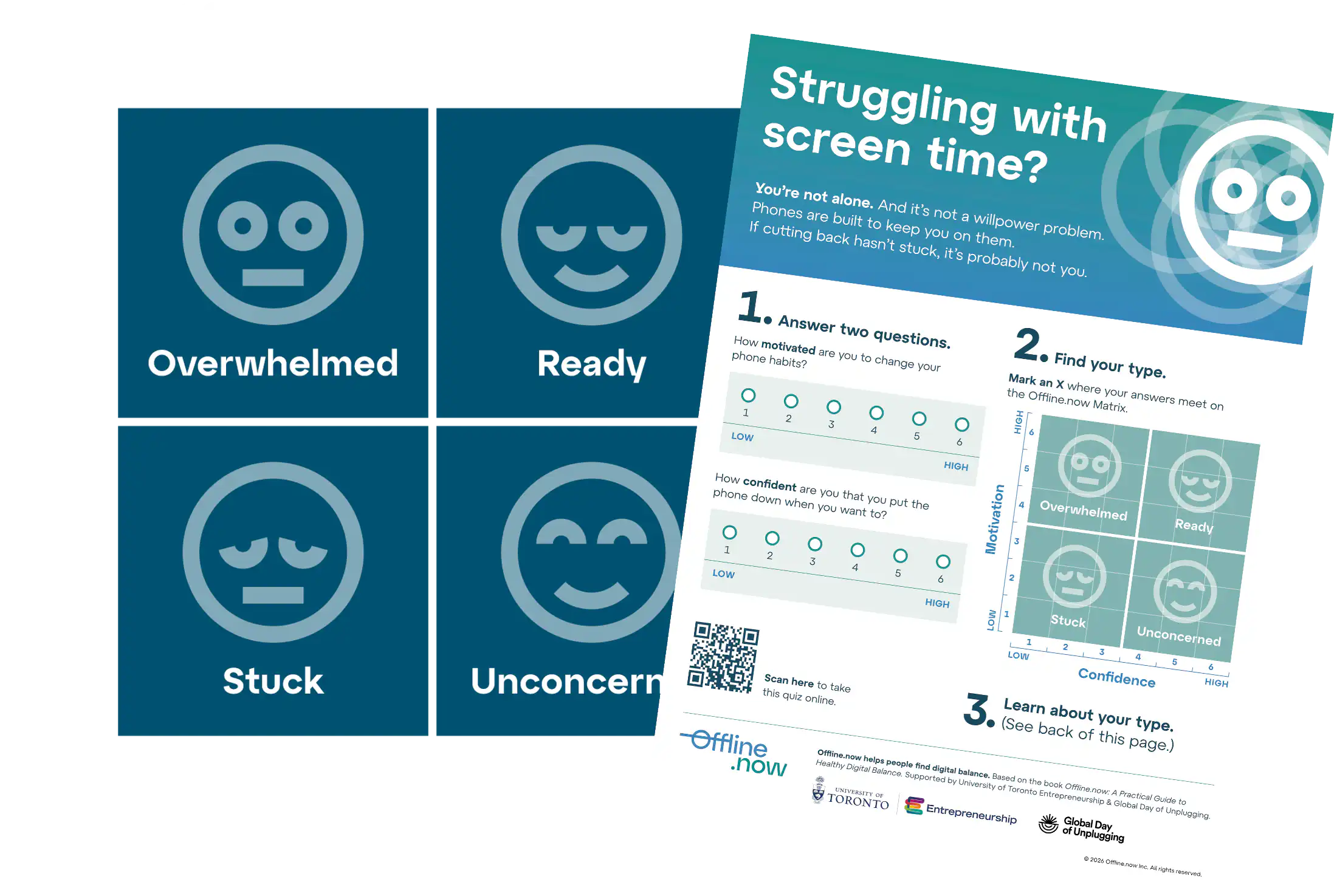
The free Find Your Starting Place worksheet
Two questions. Four starting places. One printable first step.
Download it, print it, or use it with a family, class, client, team, or community group.
No email needed to download.
Built for libraries, workplaces and schools
How it works
The worksheet is the paper version of the Offline.now Matrix. Answer two questions about motivation and confidence, find your starting place, and choose one small first step. Take the quiz online for a personalized result, or print the worksheet and use it on paper.
Use it in your community
The worksheet is free to share. Use it as a conversation starter, a workshop handout, or a simple first step for people who want a healthier relationship with screens.
Libraries
Offer it on shelves, in branch programs, or as part of digital-wellbeing displays. Co-branded versions may be available.
Schools
Give students and families a shame-free starting point for screen-habit conversations.
Workplaces
Add it to wellness programming as a practical, low-pressure first step teams can actually use.
Go deeper into the Matrix
The quiz and worksheet help you find your starting place. The book takes you further, with type-specific guidance for changing screen habits in a way that feels practical and doable.
Available at
Digital balance is an ongoing conversation
Read stories, ideas, and practical guidance from the Offline.now community.
Screens slipped quietly into the middle of our families, meals and marriages and now it’s hard to remember what being together felt like before the scroll. This guide is your starting point for rethinking phones, parenting and partnership without going full “no screens ever” mode. You’ll explore boundaries for kids and teens, desire and dating in the app era, and simple family rituals that make real connection feel possible again, even when life feels unbearably busy.
Managing screen time with ADHD can feel overwhelming from distraction spirals to hyperfocus loops to the constant pull of notifications. You don’t have to figure it out alone. Offline.now connects you with specialists who understand how ADHD brains interact with digital life. Explore experts in ADHD digital management, hyperfocus support, and executive functioning skills. Many offer free intro chats so you can find the right fit and start building healthier, more sustainable digital habits.
ADHD and your phone aren’t enemies, they’re just playing by rules nobody explained to you. This guide unpacks how dopamine, time blindness and digital overwhelm collide with your apps, and why willpower alone never works for long. You’ll get ADHD-friendly ways to study, work, scroll and rest, plus tiny experiments to rebuild focus and self-trust without pretending you’ll suddenly stop using TikTok, Instagram or YouTube, even if past systems failed and every notification still feels strangely urgent.
In a world of nonstop pings and endless feeds, it’s easy to feel overstimulated yet profoundly alone. Digital loneliness is the hidden cost of hyperconnectivity; constant online engagement that erodes real emotional connection. This article explores why being “always on” fuels stress, anxiety, and emotional fatigue, and how small, mindful “presence breaks” can help you unplug with purpose, rebuild focus, and rediscover the comfort of genuine, human connection.
Feeling relationship stress because of phones or screen time? You’re not alone and you don’t have to figure it out by yourself. At Offline.now, you can book a free intro chat with experts who understand modern relationship challenges, from device boundaries to phubbing to digital disconnect. Explore specialists in relationship stress, online dating, and family dynamics, and connect with someone who can help you rebuild clarity, communication, and real connection.
If “just one more scroll” keeps turning into an hour you didn’t mean to spend, this hub is your guide to understanding and interrupting the cycle. You’ll learn the difference between doomscrolling, zombie scrolling, and micro-scrolling, why short-form feeds feel so addictive, and how your social media habits shape anxiety, comparison, and FOMO. With gentle, realistic tools not guilt or extremes; you’ll discover small shifts that help you reclaim focus, calm, and control.