Scroll through TikTok for five minutes and you’ll hear someone blame “generational trauma” for everything from their fear of commitment to the way they load the dishwasher. The phrase has gone mainstream — and like most things that go mainstream, it’s gotten flattened along the way. It now gets used as a catch-all for “my parents were hard on me,” which both overstates it and badly undersells what it really is.
Generational trauma is real. It’s well-documented, it’s studied across psychology, neuroscience, and public health, and I see its fingerprints in my office every week. But understanding it actually helps you. The watered-down version just gives you a label. So let’s do the real thing.
What Is Generational Trauma, Really?
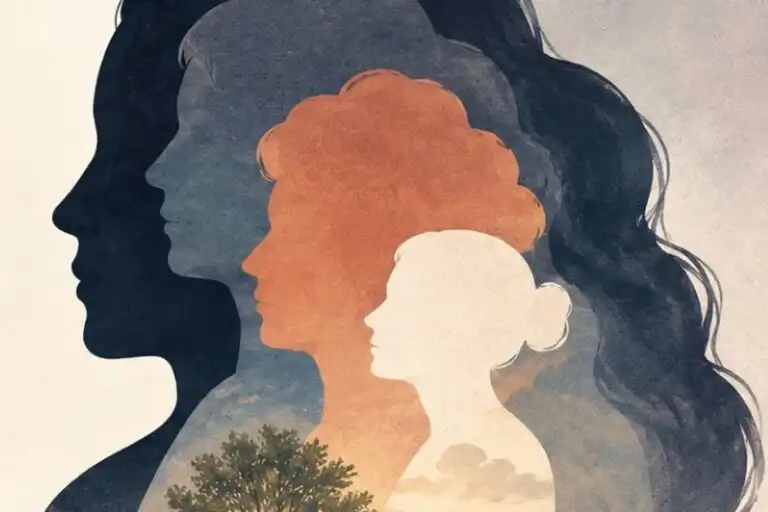
Generational trauma — you’ll also see it called intergenerational or transgenerational trauma — is the transmission of the effects of trauma from one generation to the next. The key word there is effects. Your grandmother’s specific memories don’t get downloaded into you. What gets passed down is everything those memories shaped in her: how she parented, what she believed about safety and trust, what she could and couldn’t talk about, and how her nervous system learned to brace for the world.
So a person can carry the consequences of something that happened decades before they were born — a war, displacement, poverty, abuse, addiction, a sudden loss — without ever having lived through the event itself. That’s what makes it confusing. You’re reacting to a wound you didn’t receive directly, which is exactly why it can feel like “this came out of nowhere” or “I don’t know why I’m like this.”
How Generational Trauma Gets Passed Down
There isn’t one single channel. Trauma travels between generations through at least three overlapping routes, and they usually work together.
- Learned behavior. We learn how to be people from the people who raised us — how to handle conflict, what to do with big feelings, whether it’s safe to ask for help. A parent who survived something painful and never got to process it often passes the survival strategy forward without meaning to. The child absorbs the strategy as “just how we are.”
- The family environment. Kids are remarkably good at reading the emotional weather of a home. Even young children pick up on a parent’s anxiety, tension, or emotional unavailability and adjust themselves around it. A household organized around an unspoken rule — don’t talk about that, don’t make noise, don’t need too much — teaches a child what the world requires of them long before they have words for it.
- Biology. This is the part the research keeps deepening. Chronic, severe stress appears to leave marks that influence how genes get expressed — the field of epigenetics — which may shape how a child’s stress-response system is calibrated from the start. Studies of the descendants of Holocaust survivors and other survivor populations have found differences consistent with this kind of inherited stress reactivity. The takeaway isn’t “you’re doomed by your DNA.” It’s that the body keeps a kind of record, and that record can be read by the next generation.
Inheriting a Wound vs. Inheriting a Worldview
Here’s the distinction I come back to most with clients, because it’s the one that tends to unlock things. The memory of a traumatic experience stays with the person who lived it. The worldview it created travels.
A grandparent who lived through real scarcity may have concluded, reasonably, that the world is dangerous and you can’t count on anyone but yourself. They might never say that sentence out loud. But it shows up in how tightly they hold onto money, how they flinch at change, how they struggle to let people get close. Their child grows up inside that worldview and quietly adopts it as fact. Then that child has a child. By the third generation, nobody remembers the original scarcity — they just know the family is anxious about money and bad at trusting people, and they assume that’s simply who they are.
Naming this matters because it moves the problem out of “something is wrong with me” and into “I’m carrying a story that was handed to me.” A story can be examined. A story can be put down.
Signs You Might Be Carrying Generational Trauma
This isn’t a diagnosis — think of it as a set of patterns worth getting curious about. Generational trauma often shows up as:
- Reactions that feel bigger than the situation in front of you
- Family patterns that repeat across generations — addiction, volatile relationships, estrangement, the same arguments in new bodies
- A baseline of hypervigilance or bracing that you can’t quite explain
- Trouble trusting, resting, or letting yourself need things from people
- Beliefs about love, safety, money, or worth that you’ve never actually questioned
If a few of those landed, you’re not broken and you’re not exaggerating. You’re noticing the inheritance. That noticing is the first real piece of the work.
How We Work With Generational Trauma at Personal Wellness Solutions
At Personal Wellness Solutions, my outpatient practice here in Tampa, we don’t treat your history as background information — we treat it as part of the map. When I sit down with a new client, we spend real time on the family you came from: the patterns, the unspoken rules, what got handed down and what got silenced. Not to assign blame, but to figure out which of your reactions are actually yours and which ones you’ve been carrying for someone else.
From there, the work is practical. We separate the inherited story from your present-day reality, we build the regulation skills that weren’t modeled for you, and we make space for you to decide what you want to keep and what you’re allowed to set down. Because the patterns run through relationships and, often, through addiction, that family-systems lens shapes how I work across the board. We offer both virtual and in-person sessions, so you can do this work in whatever way actually fits your life.
You Can Be the One It Stops With
The most hopeful thing about generational trauma is built right into the concept: if a pattern can be passed down, it can also be interrupted. You didn’t choose what you inherited. But you can be the generation that looks at it honestly, does something different, and hands the next one something lighter. In my world, that person has a name — a cycle breaker — and it’s genuinely some of the most meaningful work a person can do.
This is the kind of conversation Laura and I get into all the time on Therapy is Dope with Alicia and Laura, the podcast we host — the real, unfiltered, destigmatized version of healing, without the corporate gloss. If this piece resonated, that’s a good place to keep going.
Ready to start untangling what you’re carrying? Reach out to Personal Wellness Solutions at mypersonalwellnesssolutions.com to set up a session — virtual or in person.
Next in the series:
“Your Attachment Style Isn’t Your Personality — It’s Often Inherited.”