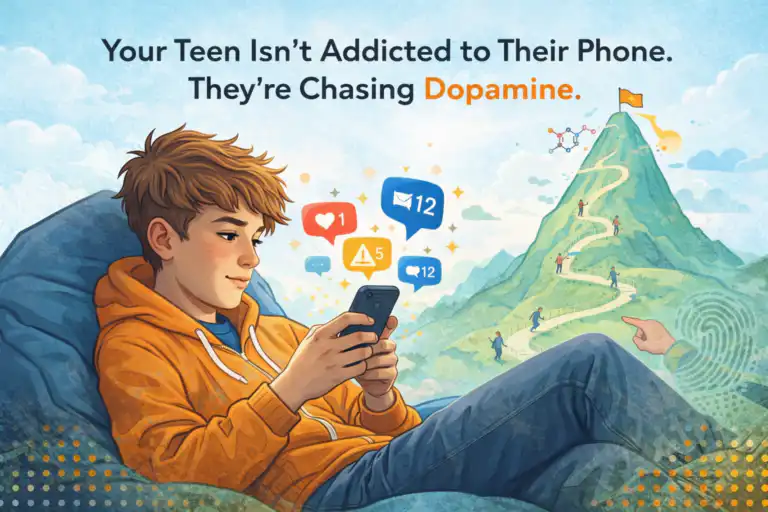
Let’s start here:
Your teen isn’t weak.
They’re not lazy.
And they’re not (necessarily) addicted.
They’re responding exactly as their brain is wired to.
And more often than not? What they’re really feeling is overwhelmed.
The Real Driver: Dopamine, Not Discipline
This isn’t a willpower issue.
It’s neurobiology.
Dopamine isn’t just about pleasure – it drives motivation, attention, and reinforcement learning. It tells the brain: this matters, do it again.
Smartphones are engineered to deliver dopamine quickly and unpredictably:
- Notifications
- Likes
- Infinite scroll
- Social feedback
This pattern, called variable reward reinforcement, is one of the most powerful ways to shape behavior (Montag & Hegelich, 2022).
And teen brains are especially vulnerable.
During adolescence, the brain’s reward system becomes more sensitive, particularly to social rewards. Basically friends and peer groups start to matter the most. At the same time, the parts of the brain responsible for impulse control and self-regulation are still under development (Dahl et al., 2022).
So when your teen keeps reaching for their phone, it’s not just a habit.
It’s a brain choosing the fastest path to feeling better.
Stress Changes the Equation
Here’s what most conversations miss:
Phone use increases when stress increases.
Recent research shows that problematic smartphone use in adolescents is significantly associated with:
- Anxiety
- Depression
- Emotional distress
(Tang et al., 2023)
That matters. Because it reframes the behavior.
Your teen isn’t just seeking stimulation. They’re seeking relief.
Addiction vs. Overwhelm
We tend to label a lot of things as addiction. But there’s a difference.
When It’s Closer to Addiction:
- Persistent compulsive use across situations
- Continued use despite serious consequences
- Loss of control regardless of emotional state
When It’s Overwhelm + Dopamine Seeking:
- Usage spikes during stressful periods
- Big emotional reactions when the phone is removed
- Irritability, shutdown, or anxiety underneath the behavior
Here’s the key:
If the phone is the main regulation tool, removing it won’t solve the problem – it will expose it.
Why Teens Are the Perfect Target
Adolescent brains are wired to:
- Seek novelty
- Prioritize peer feedback
- Respond strongly to rewards
At the same time, the prefrontal cortex – responsible for impulse control – is still developing (Dahl et al., 2022).
Now combine that with:
- Academic pressure
- Social comparison
- Constant connectivity
And then add a device that delivers:
- Instant reward
- Endless novelty
- Social validation
Of course they go back to it.
The Bigger Issue: Dopamine Imbalance
High-frequency digital stimulation can shift how the brain responds to reward.
Over time:
- Natural rewards feel less interesting
- Motivation drops
- Boredom becomes intolerable
Emerging evidence suggests that excessive digital media use may reduce sensitivity to slower, real-world rewards by overstimulating dopamine pathways (Kuss & Pontes, 2023).
So now it’s not just preference. It’s adaptation.
The Wrong Response (And Why It Backfires)
Most parents respond with:
- Screen time crackdowns
- Device removal
- “Just put it down”
But if the phone is your teen’s primary way to:
- Regulate emotion
- Escape stress
- Access reward
Removing it without replacement often leads to:
- Escalation
- Withdrawal
- Increased dependence
Not less.
The Shift: Don’t Remove Dopamine – Redistribute It
The goal isn’t less dopamine. It’s better dopamine.
Your teen doesn’t need fewer rewards. They need healthier, more sustainable ones.
What Actually Works (Backed by Brain Science)
1. Movement
Physical activity increases dopamine and improves emotional regulation (Kuss & Pontes, 2023).
2. Real-World Social Interaction
Face-to-face connection activates both dopamine and oxytocin – supporting emotional stability in ways digital interaction cannot fully replicate (Dahl et al., 2022).
3. Mastery-Based Activities
Learning and skill-building create slower, more stable reward pathways. This builds motivation, not just stimulation. Think learning an instrument or creative arts.
4. Boredom (Yes, Really)
Downtime allows the brain’s reward system to reset. Without it, everything else loses impact.
5. Reduce the Load
If overwhelm stays high, phone use will too. Look at:
- Overscheduling
- Academic pressure
- Sleep deprivation
Lower the stress. Watch what happens.
A Better Question
Instead of asking: “How do I get them off their phone?”
Ask: “What is their brain not getting anywhere else?”
Because the phone isn’t just the problem. It’s the solution they’ve found.
Final Thought
Your teen isn’t addicted to their phone. They’re:
- Overstimulated
- Overwhelmed
- And chasing the fastest dopamine available
If you only remove the phone, you remove the symptom.
If you understand the system, you change the outcome.
This is general parenting guidance, not individualized mental health care. If safety concerns are present or things feel unmanageable, seek local professional support.
About the author: Siobhan Chirico, MA, RP, OCT, is a Burlington-based registered psychotherapist and educator specializing in child and family therapy. She is the author of Climbing Crisis Mountain and a regular contributor to Today’s Parent. Learn more at climbingcrisismountain.com or visit her Offline.now profile.
References
Dahl, R.E., Allen, N.B., Wilbrecht, L., and Suleiman, A.B. (2022). Importance of investing in adolescence from a developmental science perspective. Nature, 554(7693), 441-450. https://doi.org/10.1038/nature25770
Kuss, D.J., and Pontes, H.M. (2023). Digital addiction and its psychological and neurobiological mechanisms: A review. Current Opinion in Psychology, 48, 101493. https://doi.org/10.1016/j.copsyc.2022.101493
Montag, C., and Hegelich, S. (2022). Understanding dopamine-driven social media use: A neuroscience perspective. Addictive Behaviors Reports, 15, 100411. https://doi.org/10.1016/j.abrep.2022.100411
Tang, S., Werner-Seidler, A., Torok, M., Mackinnon, A.J., and Christensen, H. (2023). The relationship between screen time and mental health in adolescents: A systematic review. Journal of Adolescent Health, 72(4), 515-528. https://doi.org/10.1016/j.jadohealth.2022.10.018