If your phone is part of why you cannot fall asleep, the answer is rarely a single setting or a one-night detox. What actually works is a repeatable system that lowers both light exposure and mental stimulation before bed, and that fits the evenings you actually have, not an ideal version of them.
That distinction matters more than it sounds. Most advice in this space assumes you just need the right tip. But if you have already tried phone-free bedrooms, app limits, and night mode, and none of it held, the missing piece is usually not information. In the Offline.now Matrix, that pattern has a name: Overwhelmed means high motivation and low confidence, so you genuinely want to change, and what you’ve tried hasn’t stuck. The failure record is evidence about step size, never about character.
Why does phone use at night cause insomnia?
Phone-related insomnia usually works through two pathways at once, and understanding both is what makes the fix stick.
The first is light. Bright screens close to bedtime can affect the body’s natural wind-down signals and delay sleep onset. This is the mechanism most people know about, and it is real, but it is also only part of the picture.
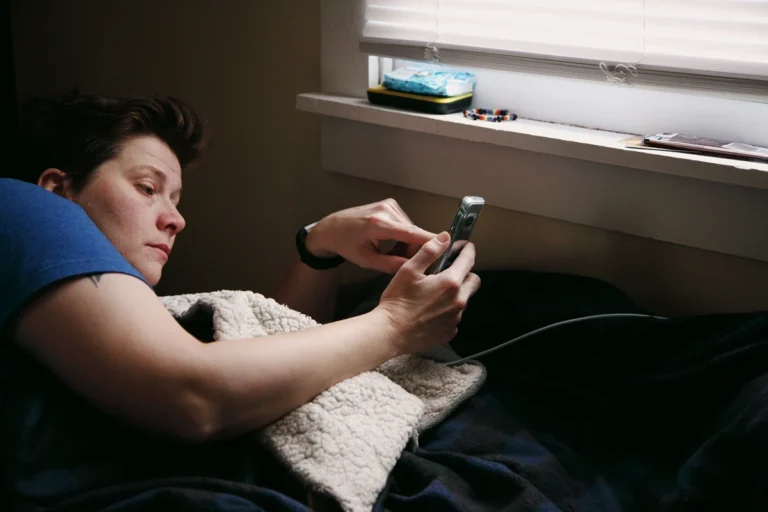
The second is mental activation. Scrolling, checking messages, reading upsetting news, or jumping between apps keeps your mind alert right when it needs to settle. If you have ever used night mode and still stayed up for another hour, you have already seen the bigger issue. The content on the phone, and the habit loop around it, usually matters more than the light it emits.
A randomized controlled trial found that blocking mobile internet for two weeks improved sustained attention by roughly the equivalent of 10 years of age-related decline, with 91% of participants improving on at least one outcome measure (Castelo et al., 2025, PNAS Nexus). The same study tracked what happened after the block ended: average daily screen time rebounded from 161 minutes during the block back to 265 within two weeks. The rebound is the pattern to plan for, not the exception.
What does not work as well as people think?
Blue light filters alone
Night mode and blue light glasses reduce one input, but they do nothing about the emotional pull of messages, social feeds, or bad news. If the phone stays in your hand for another hour on a dimmed screen, the main problem has not changed. Filters are a useful supporting step, not the intervention itself.
Willpower at the wrong moment
Late at night is exactly when self-regulation is weakest. Tired brains default to familiar, low-effort behaviors. Relying on a mental resolution made at 11 p.m. to override a habit that has been running for months is asking willpower to do a job it is not built for. Lasting change runs on confidence, not willpower: start where you actually are, with a step small enough to win.
Dramatic resets and detoxes
A systematic review of 21 digital detox studies covering 3,625 participants found effects that varied across studies, with most showing no effects or mixed findings on well-being (Radtke et al., 2022). The Castelo 2025 rebound data above tells the same story from a different angle: motivation to stop is not the same as having a system that holds. A hard reset that collapses on day four damages confidence more than it builds it.
What actually helps with phone-related insomnia?
Start by noticing your actual pattern
For some people, it’s never being able to close their work email in peace. For others it is doomscrolling because they are stressed, lonely, or too tired to do anything more effortful. The trigger shapes the fix, which is why tracking the pattern for a few nights is more useful than a general screen time total. Use the table below to notice what is actually happening before you change anything.
| What to notice | Why it matters | Example |
| First pickup time after dinner | The earlier this is, the more of your evening the habit is already claiming | 8:45 p.m. |
| Last phone use before sleep | Shows the real gap between when you want to stop and when you actually do | 12:20 a.m. |
| Main activity on the phone | Tells you whether you are managing work, filling boredom, or looking for emotional relief, each needs a different response | Work email, news scrolling |
| What triggered the pickup | Points directly to what the replacement needs to do for you | Stress, boredom, force of habit |
| Time to fall asleep | Your baseline. The number that should move if the changes are working. | 45 to 60 minutes |
Set a specific cutoff time, not a vague intention
A specific cutoff time outperforms “use my phone less” by a significant margin. If you want to be asleep by 11:30 p.m. and currently scroll until 12:30 a.m., start with an 11:00 p.m. phone-off rule. That gives you a 30-minute wind-down window and is concrete enough to repeat.
Implementation-intention research found that if-then plans improved goal attainment with an effect size of d=0.65 across 94 studies (Gollwitzer and Sheeran, 2006). A plan like “If it is 11:00 p.m., then my phone goes on the hallway charger” is substantially more effective than a general resolution. The specificity is not pedantic. It is what makes the plan executable when you are already tired.
Change the environment, not just the intention
Put the charger outside the bedroom. Use bedtime reminders. Switch to grayscale after your cutoff time. Mute non-essential notifications. Each of these reduces the friction of not picking up the phone rather than relying on a decision you make in the moment. A physical change to the environment does more than a mental resolution made while already tired.
If you need the phone nearby for emergencies or parenting, keep calls available and block everything else after your cutoff. Total removal is not the goal. A manageable boundary that holds is.
Replace the habit, not just the phone
If the phone currently provides relief, removing it without a replacement creates a gap. The brain will fill that gap with the easiest available option, which is often the phone again. Give yourself one short, low-effort wind-down alternative: paper reading, light stretching, a warm shower, or writing a few lines in a notebook. The goal is lower activation, not a virtuous evening ritual. If the replacement feels like a chore, it will not survive the first stressful week.
Build gradually, not all at once
Habit research found a median of 66 days for a new behavior to feel automatic, with a range of 18 to 254 days (Lally et al., 2010). Missing one night does not derail the process. What matters is repetition over time, not perfection on any given evening. A graduated approach holds better than a hard reset: start with a 15-minute no-phone buffer before your target sleep time, extend it once it feels normal, then adjust the cutoff.
When you slip, that is not failure. It is information about which part of the plan needs adjusting: the timing, the replacement activity, or the environment change. The Offline.now Matrix is a self-reflection framework that maps your motivation to change your phone habits against your confidence that you can, and sorts the result into four types, each with its own starting place. If you have been trying and not holding, the starting place is probably smaller than the one you have been attempting.
When does phone-related insomnia need more than habit change?
If a more structured approach to your phone habits improves things within two or three weeks, keep going and add one change at a time. Protect what works before expanding it.
If sleep difficulty persists after making genuine environmental and behavioral changes, the problem may have layers that habit change alone cannot address. A practitioner who understands the overlap between phone habits, stress, and sleep can help identify what is driving the pattern and what the next step looks like. The Offline.now expert directory lists practitioners who work specifically in this space.
The free quiz at Offline.now takes two questions and less than a minute. It shows you your type, whether that is Stuck, Overwhelmed, Ready, or Unconcerned, and points you to your starting place. The Find Your Starting Place worksheet does the same thing on paper: one page, free to download, no account required.
Frequently asked questions
What actually helps with insomnia caused by phone use at night?
A specific cutoff time, an environmental change that removes the phone from arm’s reach, a low-effort replacement activity, and gradual repetition. Blue light filters help as a supporting step but are not the main intervention. The system that holds is the one sized to the evenings you actually have.
Does blue light filtering improve sleep?
Sometimes, a little. It is most useful as a supporting step alongside behavioral changes, not as the primary fix. A dimmed screen showing stressful content still activates the brain. The content and the habit loop around it tend to matter more than the light.
How does phone use before bed affect sleep and what can I realistically change?
Phone use before bed delays sleep through light and mental activation. What you can realistically change depends on where you are starting from. A 15-minute no-phone buffer is a smaller and more repeatable first step than a phone-free bedroom, especially if you have tried and not held the bigger version. The Offline.now Matrix helps you identify which type you are so the first step fits your actual state.
Can willpower alone stop nighttime phone use?
Rarely, and least of all at night when self-regulation is already depleted. Environmental changes and specific if-then plans outperform general intentions in the research. The goal is to make the sleep-friendly option the easier option, not to summon more discipline at the moment when you have the least of it.
Curious about the data?
Castelo, N., et al. (2025). Blocking mobile internet on smartphones improves sustained attention, mental health, and subjective well-being. PNAS Nexus.
https://doi.org/10.1093/pnasnexus/pgaf017
Radtke, T., et al. (2022). Digital detox: an effective solution? Systematic review, 21 studies. Mobile Media and Communication.
https://doi.org/10.1177/20501579211028647
Gollwitzer, P., and Sheeran, P. (2006). Implementation intentions. Advances in Experimental Social Psychology.
https://doi.org/10.1016/S0065-2601(06)38002-1
Lally, P., et al. (2010). How are habits formed. European Journal of Social Psychology.
https://doi.org/10.1002/ejsp.674
Offline.now provides coaching-oriented guidance, not diagnosis or medical advice. If digital habits are creating significant distress, working with a qualified practitioner is a strong next step. The Offline.now expert directory is a good place to start.