Offline.now editorial, reviewed by Eli Singer. Reviewed November 27, 2026.
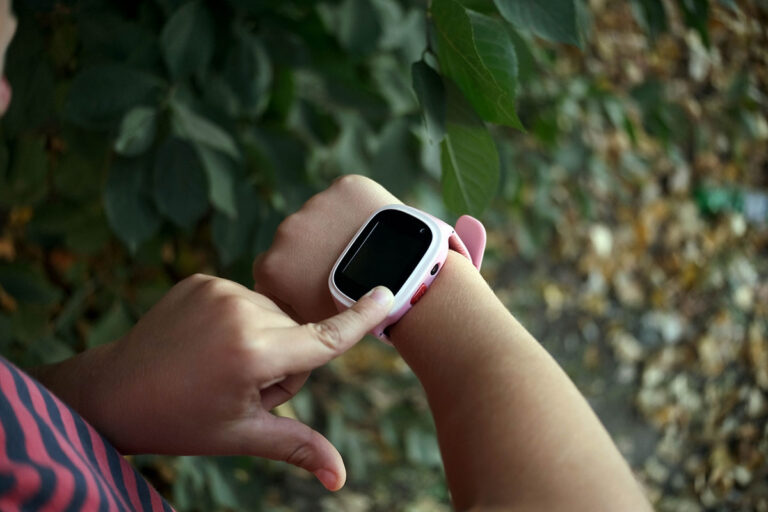
A kids’ smartwatch lets your child call, text and share their location without the apps and feeds of a smartphone. The Gabb Watch 3e is the simplest option. The Bark Watch adds message monitoring. The Garmin Bounce 2 suits active kids, and an Apple Watch makes sense if a parent already uses an iPhone.
Many families use a watch in the years before a first phone. In a 2025 Pew Research Center survey, 29% of parents of 8 to 10 year olds said their child already had a smartphone of their own. The share roughly doubled for 11 and 12 year olds (Pew Research Center, 2025).
Kids tend to copy the phone habits they see at home. If you want to look at your own first, find your starting place with two quick questions.
The Offline.now Matrix is a self-reflection framework that maps your motivation to change your phone habits against your confidence that you can, and sorts the result into four types, each with its own starting place. For parents, the type that matters first is your own. If you want fewer screen fights at home and the rules keep slipping, you may be Overwhelmed. Overwhelmed means high motivation and low confidence, so you genuinely want to change, and what you’ve tried hasn’t stuck.
Offline.now is a directory of therapists and coaches who work on screen and phone use, and the home of the Offline.now Matrix, a two-question self-reflection framework that finds your starting place. Offline.now meets you where you are. Its approach to phone habits has no shame, no judgment and no detox, and the first step is sized to you.
This comparison carries no affiliate links. Prices were checked on makers’ and retailers’ pages on November 18, 2026, in US dollars unless marked.
Which kids’ smartwatch fits? The short answer
Pick the Gabb Watch 3e if you want calls, texts and location with nothing else on the wrist. Pick the Bark Watch if you want to see the messages. Pick the Garmin Bounce 2 if your child plays sport and you are in Canada or the US. Pick an Apple Watch if a parent has an iPhone and you want the watch to grow with your child.
| Watch | Price (checked Nov 18, 2026) | Monthly plan | Calls and texts | Location | What it leaves out | Canada |
|---|---|---|---|---|---|---|
| Gabb Watch 3e | $149.99, plus $30 activation | $12.99 to $17.99, by contract length | Approved contacts, voice messages, speech to text | GPS with safe zones | Internet, apps, games, camera | Not confirmed |
| Bark Watch | $288, or paid over time | $15 | Approved contacts, with message monitoring | GPS | Games, social media, browser | US only, per Bark |
| Garmin Bounce 2 | $299.99 (C$399.99) | $9.99 or $99.99 a year (C$14.99 or C$149.99) | Two-way calls, texts and voice messages through the Garmin Jr. app | GPS, live tracking | Browser and social apps | Yes |
| Apple Watch with cellular | From about $299 for a cellular SE | A carrier plan, which varies | Approved contacts | Find My | Needs a parent’s iPhone; apps stay, with limits | Yes, with Bell, Rogers, SaskTel and Telus |
What does the Gabb Watch 3e let your child do?
The Gabb Watch 3e does three things: calls, texts and location. Kids can text with speech to text, send audio messages and join group texts with contacts a parent approves. Parents can set safe zones that send an alert when the watch leaves them (Gabb).
It has no internet, no app store, no games and no camera. The watch is $149.99 with a $30 activation fee. The plan runs $12.99 a month on a two-year contract, $14.99 on one year and $17.99 with no contract.
In a Gabb Watch vs Bark Watch decision, Gabb is the simpler watch, with less for your child to check.
What does the Bark Watch monitor?
The Bark Watch is a Samsung Galaxy Watch8 with Bark’s parental controls built in. Kids can call and text over LTE, and parents see alerts when Bark’s system flags something in texts, photos or videos, along with GPS location and contact approval (Bark).
There are no games, no social media and no browser. Bark lists the watch at $288, with a separate $15 monthly plan that covers cell service and a family Bark subscription. Bark says the watch is sold only to families in the US.
The trade-off is monitoring. Bark shows parents more of what is said. Gabb gives the child less to do on the watch.
Is the Garmin Bounce 2 worth $300?
The Garmin Bounce 2 is worth it if your child moves a lot and you want calls, texts and live tracking in a sports watch. It has a 1.2-inch AMOLED screen, built-in activity tracking, two-way calling, text and voice messages through the Garmin Jr. app, and up to two days of battery with moderate use (Garmin Canada pricing via iPhone in Canada).
The downside is cost. The watch doubled in price from the first Bounce, and every connected feature needs Garmin’s own LTE plan. In Canada that plan is C$14.99 a month or C$149.99 a year and covers Canada and the US.
It is also the only watch here that its maker sells and supports in Canada.
When does an Apple Watch for kids make sense?
An Apple Watch for kids makes sense when a parent already has an iPhone and you expect the watch to stay useful for years. Apple Watch For Your Kids, once called Family Setup, lets a parent set up a cellular Apple Watch SE or Series 6 or later for a child in the same Family Sharing group (Apple).
Parents manage approved contacts, turn on Apple Watch Schooltime during class hours and see location in Find My. The watch needs its own carrier plan. In Canada, Bell, Rogers, SaskTel and Telus support it.
The trade-off is that it does more. An Apple Watch can run apps and has an App Store with Ask to Buy, so it is a smaller step away from a phone than the others.
What about the Fitbit Ace LTE, TickTalk 5 or Gizmo Watch 3?
These are the next three most searched kids’ watches, and each fits a narrower case.
| Watch | What stands out | Plan |
|---|---|---|
| Fitbit Ace LTE | Movement games, School Time; kids cannot message each other | Ace Pass, $9.99 a month or $119.99 a year |
| TickTalk 5 | Video calling, $159.99 | Monthly plan required |
| Gizmo Watch 3 | Verizon’s own watch, $149.99 | $10 a month on Verizon |
Each is a GPS watch for kids with calling. Check which carrier it runs on, and whether it works where you live, before you order.
Does a watch delay the first phone?
No study has tested whether a smartwatch delays a first smartphone. The data does show when phones tend to arrive. In the UK, Ofcom found smartphone ownership jumps from 56% of 10 year olds to 83% of 11 year olds, around the move to secondary school (Ofcom, 2026).
A kids phone watch can cover the two or three years before that jump. The American Academy of Pediatrics now puts less weight on a single hour count and more on how a device is designed and what it crowds out (Munzer et al., 2026). A watch without apps or a feed leaves more room for sleep, school and play.
What should the family agree on before the watch arrives?
Before the watch arrives, agree on three things: who can call, when the watch goes quiet, and where it charges at night. Our family phone agreement has a free template you can adapt to a watch in five minutes.
Lasting change runs on confidence, not willpower. A watch rule a child helped write is easier to keep than one handed down. If a phone is next, our comparison of Bark, Gabb, Pinwheel and Troomi phones picks up where this one ends.
Frequently asked questions
Gabb watch vs Bark watch: which is better?
The Gabb Watch 3e costs less and has fewer features, so there is less to manage. The Bark Watch adds message monitoring and runs on a Samsung watch, at a higher price. Pick Gabb for simplicity and Bark if you want to see messages.
Which kids’ smartwatch has no monthly fee?
None of the four main watches works fully without a plan. Calling, texting and live location all need cellular service. A watch with no plan can only track activity and tell time.
Which kids’ watches work in Canada?
The Garmin Bounce 2 and a cellular Apple Watch both work in Canada. Bark says its watch is US only, and we could not confirm Canadian service for the Gabb Watch 3e.
What age is right for a kids’ smartwatch?
There is no official age. Garmin lists the Bounce 2 for ages 6 and up. Most families use a watch in the years before a first phone, often from about 7 to 11.
Where do I start?
Start with your own phone habits, since kids copy them. The two-question check sorts you into one of four types with a first step that fits. The worksheet does the same thing on paper.
Next steps
A watch is a reasonable first step. It works best when the adults in the house are working on their own phone habits too.
If you want a different way to change your screen habits, one with no shame and no judgment, Offline.now was built for you. Start with the two questions at offline.now/start. They take about a minute and sort you into one of four types, each with its own starting place. The Find Your Starting Place worksheet does the same thing on paper: one page, free to download, no email required. After the quiz, the Offline.now Program is the next step. Use it on the web and by email, with no download. There is no streak to lose and no password to remember.
If phone rules have turned into a nightly argument, the Offline.now directory lists therapists and coaches who work on parental modelling. Our guide to why we reach for phones in quiet family moments shows how a parent’s habits travel.
Offline.now provides coaching-oriented guidance, not diagnosis or medical advice. If digital habits are creating significant distress, working with a qualified practitioner is a strong next step. The Offline.now expert directory is a good place to start.
Curious about the data?
Pew Research Center. (2025, October 8). How Parents Manage Screen Time for Kids. pewresearch.org
Ofcom. (2026, May 21). Younger phone owners, the rise of AI, and consumption over creation: our latest look at UK children’s media lives. ofcom.org.uk
Munzer, T., Parga-Belinkie, J., Milkovich, L. M., Tomopoulos, S., Ajumobi, T., and colleagues. (2026). Digital Ecosystems, Children, and Adolescents: Policy Statement. Pediatrics. https://doi.org/10.1542/peds.2025-075320
Gabb. Service plans and Gabb Watch 3e pages, checked November 18, 2026. gabb.com
Bark. Products and pricing page, checked November 18, 2026. bark.us
Garmin Bounce 2 Canadian pricing as reported by iPhone in Canada; US pricing from Garmin listings. Checked November 18, 2026. iphoneincanada.ca
Apple. Set up Apple Watch For Your Kids (Apple Watch User Guide), checked November 18, 2026. support.apple.com