
Stuck: Low Motivation, Low Confidence
Stuck means low motivation and low confidence: your phone habits bother you, but change feels pointless, so nothing gets started. If that’s you, nobody here is going to pep-talk you. This page explains the flatness and offers one spark, not a plan.
Stuck is one of four types in the Offline.now Matrix, which maps your motivation to change your phone habits against your confidence that you can, and gives each combination its own starting place. If you’d rather begin than read, find your starting place now, or go straight to the Find Your Starting Place worksheet and choose your first step on paper.
What being Stuck feels like
Being Stuck feels flat. You can see the hours going somewhere you didn’t choose, and the seeing doesn’t move you, because trying seems pointless and past attempts back that up. This page won’t argue you into caring. It starts smaller than that.
You scroll past your own screen-time report without opening it, because it doesn’t feel like information you can use.
Advice lands on you like weather. Someone shares a documentary, a friend does a detox, and you nod along and feel nothing move.
You’ve half-tried before. A limit you set once and never reset, an app you meant to delete. The memory of those half-tries is part of why starting again feels pointless.
When people ask if your phone bothers you, the honest answer is yes, followed by a shrug. Both halves are real, and this page respects both.
Weekends are the tell. A free Saturday afternoon disappears into the phone, and the feeling afterward is less guilt than static.
The bothered half is everywhere, for what it’s worth. In a 2022 Gallup survey, 58% of U.S. adults said they use their smartphone too much, up from 39% in 2015 (Gallup, 2022). The full sourced set lives at phone habits statistics.
Why it happens
Stuck happens when motivation and confidence are both low, and each keeps the other down. Motivation is low: the case for changing feels weak, or too abstract to act on. Confidence is low: nothing you’ve tried has held, so effort looks like a bad bet. On the Matrix, that’s the low motivation, low confidence cell, and it’s stable by design: nothing starts, so nothing disproves the story.
Behavior-change research treats forming the intention to change and acting on it as separate processes with separate predictors (Schwarzer, 2008). Stuck sits before the first one. The intention hasn’t formed yet, so advice aimed at execution has nothing to attach to, which is why plans bounce off this state.
The confidence side is self-efficacy, your belief in your capability to make a specific change, and it predicts whether people start at all (Bandura, 1977). When it’s low, the mind protects you from another loss by declining to enter the race. The flatness is partly self-protection, and it deserves some respect before it gets worked on. None of this means you’re lazy. It means the machinery that starts change hasn’t been given a part small enough to turn.
What actually helps when you're Stuck
What helps when you’re Stuck is one spark, not a plan. A plan assumes fuel you don’t have yet. A spark just needs one moment of contact.
Notice once, on purpose. Pick a single moment today to notice where your attention went, without changing anything. Awareness with no assignment attached is a real first step, and for this cell it’s the right size.
Name the exact moment. Even a spark lands better with a time and place attached. Deciding in advance exactly when and where you’ll act improved follow-through with a medium-to-large effect across 94 studies (d = 0.65; Gollwitzer & Sheeran, 2006). One honest version: when I get into bed, I notice where the phone is.
Lower the bar to curiosity. You don’t need to want change yet. Wanting to know what’s true is enough, and one question, like what am I reaching for when I reach for it, can do more here than any rule.
Let a small win argue for you. Belief in your capability grows from evidence, and evidence starts with one kept moment (Bandura, 1977). Don’t build a case in your head. Collect one data point.
What doesn't help
Enthusiasm-first advice doesn’t help this type, and neither do commitments. Programs built on motivation ask for the one resource this cell is out of, and every unopened program becomes more proof that you’re the problem. You were never the problem. The starting line was in the wrong place.
Detoxes and strict limits are a worse fit still. They’re built for people already burning to change, so for a Stuck person they mostly generate guilt without contact, and guilt deepens the flatness it claims to cure. Accountability setups misfire here for the same reason: a partner checking on goals you never believed in just adds an audience to the flatness. The approach on this site runs the other way. Lasting change runs on confidence, not willpower: start where you actually are, with a step small enough to win.
FAQ
What does it mean to be Stuck?
Stuck means low motivation and low confidence: your phone habits bother you, but change feels pointless, so nothing gets started. It’s one of four types in the Offline.now Matrix, and it’s a state, never a verdict. The starting place for this state is smaller than advice usually gets: one spark, not a plan.
Why don’t I care about my screen time even though I think I should?
Because thinking you should and wanting to are different systems, and the wanting hasn’t formed yet. Behavior-change research treats forming an intention and acting on it as separate processes. Low confidence keeps the wanting from forming: when effort looks like a bad bet, the mind stops placing it. That’s mechanics, never character.
Can anything change if I have no motivation?
Yes, because the first move doesn’t need motivation. Noticing one moment on purpose asks only for curiosity, and curiosity survives flatness. Small wins then do the persuading that pep talks can’t: each one is evidence, and belief follows evidence. Motivation is usually a result of change starting, and rarely the requirement.
What is the smallest possible first step?
One noticing, chosen in advance. Tonight, when you get into bed, notice where the phone is and what you feel. That’s the whole assignment, and no change is required. The Find Your Starting Place worksheet is one page that turns your type into a first step you choose yourself.
Is being Stuck the same as depression?
No. Stuck describes your current relationship with your phone habits, and nothing more. It’s a self-reflection label, never a clinical one. Depression is a medical matter with real help available. If low mood, low energy, or numbness reaches beyond your screen habits, please talk to a doctor or a qualified mental health professional.
Where to go next
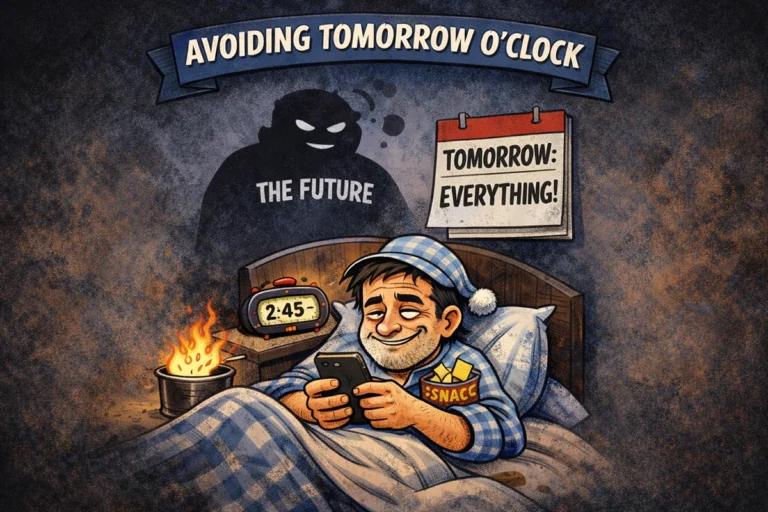
Three good next reads from the blog: How to Change When You Don’t Even Know Where to Start, You’re Not Addicted to Your Phone, You’re Avoiding Tomorrow, and Resolution Overload: Why You Don’t Need a Reinvention, Just a Reset.
If this doesn’t sound quite right, you may be nearby. Bothered enough that you’ve genuinely tried? You may be Overwhelmed. Untroubled rather than flat? You may be Unconcerned.
For the full framework, read the Offline.now Matrix. The free quiz is two questions and takes less than a minute: it shows you your type and points you to your starting place. Take it at find your starting place, or download the Find Your Starting Place worksheet and choose your first step on paper.
Updated July 2026
Offline.now provides coaching tips, not therapy or medical advice. If you’re experiencing deeper issues, consider seeking professional support.
Meet the experts that specialized in being Stuck



Blog posts related to feeling Stuck


Go deeper into the Matrix
The quiz and worksheet help you find your starting place. The book takes you further, with type-specific guidance for changing screen habits in a way that feels practical and doable.

