Blog
Welcome to the Offline.now Blog - your trusted resource for navigating digital detox and reclaiming balance.
Explore daily insights into managing phone stress, reducing screen time, curbing doomscrolling, and practical digital wellness strategies. Let our science-backed tips and expert advice empower you to build a healthy relationship with technology.
53% of U.S. adults say they use their phone too much (Pew, 2026). No test diagnoses phone addiction. Two questions that tell you where to start.
Opal, one sec, Brick, Cold Turkey, ScreenZen and Forest compared on four criteria. In one trial a block cut screen time from 314 to 161 minutes.
43 studies link bedtime procrastination to shorter, worse sleep. Why the late hour feels earned, and the 20-minute step that moves it.
Adults spend 6 hours 38 minutes a day online (GWI). What counts as too much screen time in 2026, and the one setup change that beats a cap.
Batching notifications three times a day cut stress in a trial of 237 adults; turning them all off raised anxiety. The settings to change, in order.
Teens who used their phones more after 10 p.m. slept 20 minutes less (Zhao, 2026). The phone rules that hold name one place and one time.
ADHD symptoms and problematic social media use correlate at 0.36 across 15 studies (Ding, 2025). Why the phone pulls harder, and what helps.
Doomscrolling is linked to anxiety across 44 studies (Li and Yin, 2026). What the word means, what it does to you, and the setup change that holds.
Digital burnout has five sources, and 84 pooled studies show each has its own cause (Kotek, 2025). The signs, the loop, and the first step back.
A 30-minute phone-free buffer cut time to fall asleep in a four-week trial (He, 2020). The 15-minute evening reset: three steps, phone first.
Phone use and sleep problems correlate at 0.38 across 63 studies (Okunlola, 2026). What helps with insomnia from night phone use, in order.
64% of adults 30 to 49 say they use their phone too much (Pew, 2026). Why interruptions cost more than hours, and the one window to protect first.
If you keep picking up your phone without meaning to, you’re not lacking discipline—you’re stuck in a loop. This post breaks down why compulsive checking happens and introduces a simple 3-part framework to interrupt it: recognize the trigger, insert one small pause, and add gentle friction to the environment. With practical scripts and a 24-hour experiment, you’ll have something concrete to try tonight—no shame, no detox required.
If you keep switching between email, Slack, and social media yet feel like nothing gets done, you may be experiencing task-switching debt. For ADHD brains, every unfinished task creates cognitive tension that quietly pulls attention back again and again. This post explains how switching debt builds throughout the day and shares simple micro-experiments to reduce open loops, lower mental fatigue, and make it easier to return to the work that actually matters.
When your phone is your business, “just put it away” isn’t realistic. But constant access can quietly destroy focus—especially for ADHD brains wired for novelty. In this personal reflection, an ADHD coach shares how late-night and early-morning doom scrolling was hijacking his attention and nervous system, and how one surprisingly simple change—a smart watch alarm—created friction that protected his focus without disconnecting him from work.
Late-night doom scrolling isn’t really about the phone—it’s about exhaustion, unfinished tasks, and an ADHD brain searching for relief. When the day feels overwhelming and nothing feels complete, endless scrolling offers easy stimulation without expectations. This post explores why burnout and ADHD make nighttime scrolling so common, and how small daytime shifts—like visible task completion and planned endings—can help your brain finally power down instead of staying stuck in the scroll.
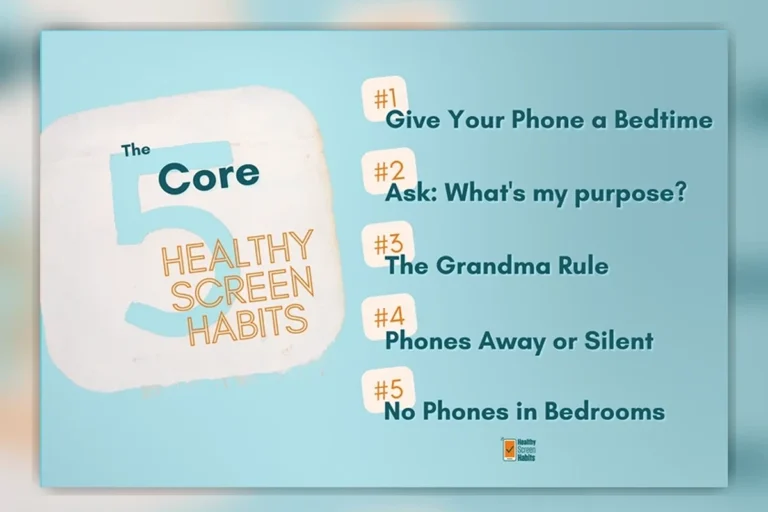
Healthy Screen Habits is helping families rethink screen time with simple, practical habits that prioritize connection over control. Instead of rigid rules or panic, their approach focuses on small, repeatable changes that make technology easier to manage in everyday life. In this post, we highlight their 5 Core Healthy Screen Habits and share a simple 7-day family experiment—small steps that can reduce digital overwhelm and help screens take up less space at home.
If your brain won’t shut up and scrolling leaves you more exhausted, you may be in ADHD burnout. This post explains why ADHD brains burn out differently, how screen time creates a false sense of relief, and why willpower isn’t the solution. With practical, brain-aligned strategies for protecting energy, setting boundaries, and prioritizing real rest, you’ll learn how to recover without forcing yourself to “try harder.”