Blog

Welcome to the Offline.now Blog - your trusted resource for navigating digital detox and reclaiming balance.

Explore daily insights into managing phone stress, reducing screen time, curbing doomscrolling, and practical digital wellness strategies. Let our science-backed tips and expert advice empower you to build a healthy relationship with technology.
No trial has tested the dopamine detox, and 21 digital detox studies came back mixed (Radtke, 2022). What the evidence supports, and a first step.
Across 43 studies, 21% report severe nomophobia (Al-Mamun, 2025). What the fear is made of, and the step that keeps the lifeline.
53% of U.S. adults say they use their phone too much (Pew, 2026). No test diagnoses phone addiction. Two questions that tell you where to start.
Opal, one sec, Brick, Cold Turkey, ScreenZen and Forest compared on four criteria. In one trial a block cut screen time from 314 to 161 minutes.
43 studies link bedtime procrastination to shorter, worse sleep. Why the late hour feels earned, and the 20-minute step that moves it.
Adults spend 6 hours 38 minutes a day online (GWI). What counts as too much screen time in 2026, and the one setup change that beats a cap.
Batching notifications three times a day cut stress in a trial of 237 adults; turning them all off raised anxiety. The settings to change, in order.
Teens who used their phones more after 10 p.m. slept 20 minutes less (Zhao, 2026). The phone rules that hold name one place and one time.
ADHD symptoms and problematic social media use correlate at 0.36 across 15 studies (Ding, 2025). Why the phone pulls harder, and what helps.
Doomscrolling is linked to anxiety across 44 studies (Li and Yin, 2026). What the word means, what it does to you, and the setup change that holds.
Digital burnout has five sources, and 84 pooled studies show each has its own cause (Kotek, 2025). The signs, the loop, and the first step back.
A 30-minute phone-free buffer cut time to fall asleep in a four-week trial (He, 2020). The 15-minute evening reset: three steps, phone first.
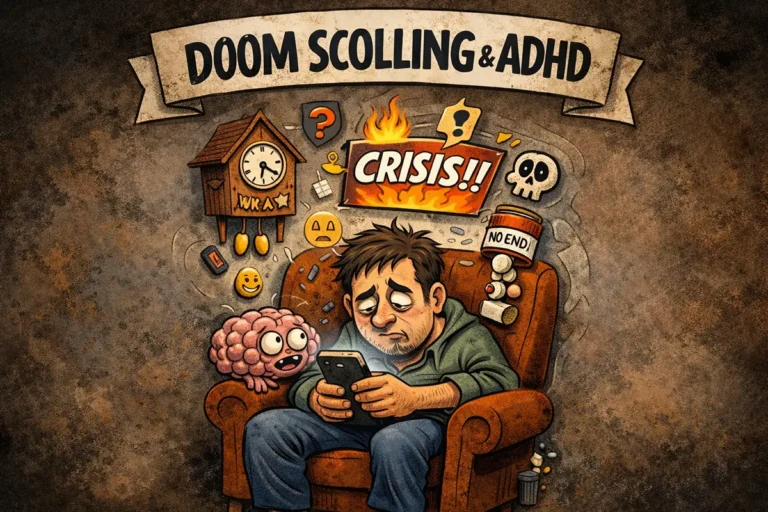
If you have ADHD, doom scrolling isn’t about laziness or poor discipline—it’s what happens when a novelty-seeking brain meets infinite scroll and threat-based content. This post breaks down why ADHD brains are especially vulnerable to doom scrolling, how anxiety can hijack attention, and why shame doesn’t work. Instead of “scroll less” advice, you’ll learn how to change the environment, add real stopping cues, and give your brain somewhere safe to land.
Are Snapchat and TikTok actually dangerous for teens? The real risk isn’t the apps themselves—it’s how they blur privacy, permanence, and performance in ways adolescent brains aren’t equipped to manage. Drawing on clinical work and lived parenting experience, this post explains how online harm often unfolds, why shame makes safety worse, and how families can use practical, non-judgmental tools to help teens protect their agency, make safer choices, and ask for help before mistakes become permanent.
Most of us want change without discomfort, yet friction is often the first sign that something new is beginning. This post explores what it truly means to be “change ready,” why mindset matters more than willpower, and how resistance signals growth rather than failure. By shifting your internal narrative and reclaiming a sense of agency, you can move out of old patterns and toward meaningful, sustainable change—even in a world designed to keep you comfortable and distracted.
Even with constant contact, many of us still feel alone. Digital messages keep us informed, but they don’t always make us feel known. This post explores why digital closeness can’t replace real intimacy—and how passive scrolling, texting, and divided attention quietly erode connection. Learn the difference between “warm” and “cold” interactions, why presence matters more than frequency, and three simple rituals to turn everyday communication into deeper, more satisfying relationships.
Late-night symptom searching often starts with reassurance and ends in panic. When uncertainty meets endless medical content, anxious brains fixate on worst-case explanations—a pattern known as cyberchondria. Fatigue, doomscrolling, and reduced self-control at night make the spiral worse, not better. This piece explains why “just Googling it” backfires and offers a gentle Pause and Ground approach to interrupt the loop, protect your nervous system, and regain calm without ignoring your health.
When emotions run high, texting can turn small misunderstandings into full-blown arguments. Without tone, body language, or real-time feedback, our brains fill in the gaps—often with stress and assumption. This post explores why texting arguments escalate so quickly and introduces a simple Pause and Redirect framework to reduce digital conflict. Learn how creating distance, checking in with your nervous system, and moving hard conversations off-screen can protect connection and restore calm.