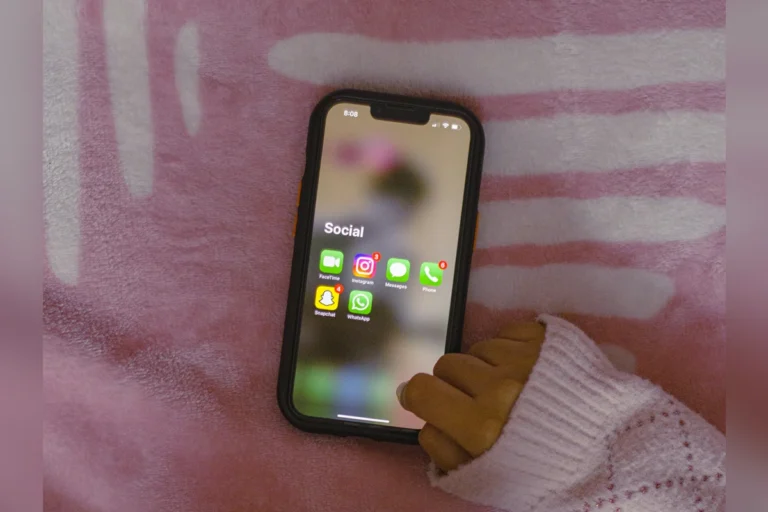
You close the LinkedIn app feeling worse than when you opened it. You meant to put your phone away at dinner and did not manage to follow through. You took a weekend off screens last spring and by Monday everything had drifted back to where it started. These are not failures of willpower. They are signals worth paying attention to. Fomo is ever present in our lives.
According to the APA’s 2025 Stress in America report, decision fatigue and digital overwhelm rank among the most consistent sources of stress for working adults. The volume of inputs is not the whole problem. The problem is that most people have never built a clear relationship with their screens, and without one, the default is to be led by them rather than to lead.
This piece covers four patterns that show up together in coaching work with professionals navigating that shift: LinkedIn anxiety, tech friction in relationships, and what it actually takes to plan and implement a digital reset that holds. Before diving in, it helps to know which of four states you are starting from: Stuck, Overwhelmed, Ready, or Unconcerned. The Offline.now Matrix sorts that out in two questions, and the guidance below lands differently depending on which one fits you.
A Quick Way to See Where You Are
The table below maps the four patterns covered in this article to what is actually driving them and where to start. It is a map, not a diagnosis.
| If This Sounds Like You | What Is Actually Happening | Where to Start |
| You feel behind after scrolling LinkedIn | Comparison to curated highlights, not an accurate read of your own progress | Clarify your own benchmark before you open the app |
| Your phone is creating friction with a partner or family member | An unspoken message about priority, not a phone problem on its own | Build a specific, mutual boundary instead of a general rule |
| You want to change your habits but do not know where to begin | A plan built before the current state was accurately identified | Take the Matrix and start with one small, specific change |
| You have tried a reset before and it did not hold | An environment that was not changed, only an intention that was | Change what is easy, not just what you intend to do |
What LinkedIn FOMO Is Actually Telling You
LinkedIn has a particular kind of pull: different from doomscrolling, different from news feeds. It is professional comparison at scale, and for people who care about their work, it hits harder. A peer’s promotion, a founder’s growth milestone, a conference you did not attend: the platform surfaces all of it in a scroll that never ends.
The comparison that happens there is not incidental. LinkedIn is structured to surface high points: announcements, wins, visible momentum. What you are comparing yourself to is not a peer’s actual career. It is a curated highlight reel. The gap between what you see there and where you are right now is not an accurate measure of anything.
That said, the discomfort is a signal. If professional comparison is consistently leaving you feeling stuck or behind, that feeling is pointing at something worth untangling. The question is not what everyone else is doing. It is what clarity looks like for you right now, and what would help you think more clearly about what comes next.
Eli Singer, Certified Professional Coach at Offline.now, specializes in professionals navigating digital overwhelm and career transitions, and leaders who need to think more clearly about what comes next. His observation is consistent: the professionals who get the most stuck in LinkedIn anxiety are not the ones who are actually behind. They are the ones who have lost their own benchmark for progress and replaced it with someone else’s feed.
The practical move is not to log off permanently. It is to clarify the signal before the scroll. A five-minute session with a clear purpose is a different experience than an open-ended check that ends when the discomfort does.
When the Phone Gets Between You and the People You Are With
The pattern shows up in most relationships at some point. One person reaches for their phone. The other person notices. Something small happens: a withdrawal, a comment, a quiet frustration. Over time, small moments like that accumulate into something larger.
Tech tension in relationships is less about the phone itself and more about what the phone represents in the moment. When someone picks up their device during a conversation, the message (intended or not) is that something else has priority. That interpretation is hard to talk around, even when it is not accurate.
A Gallup survey found that more than two-thirds of American adults keep their phone nearby while sleeping. That same proximity shapes the rhythm of a relationship: first thing in the morning, last thing at night, and every charged moment in between.
Healthy tech boundaries in relationships are not rules imposed from outside. They are agreements built together, based on what two people actually need. The most workable ones are specific, not general:
- Not “be more present” but “phones away during dinner”
- Not “stop checking work messages at night” but “no notifications after 9 p.m. unless it is something we have agreed matters”
- Not “use your phone less” but “when I am talking to you, I will put it face down”
Vague agreements fail because the edge cases never get resolved. Specific ones give people something to actually hold each other to, without the conversation turning into a negotiation every time.
Nighttime tends to be where this shows up hardest, since it is the point where phone habits and relationship habits overlap the most.
The pull to check one more thing before sleep is usually the same habit that is shaping the friction during the day, and it is worth understanding on its own terms: why checking your phone at night is so hard to stop goes deeper into that pattern specifically.
Planning a Digital Reset That Does Not Collapse by Monday
Most digital detox attempts fail not because the person lacks motivation but because the plan was built for a version of their life that does not exist. A four-day screen sabbatical sounds sustainable until Monday morning arrives with its inbox.
A plan that holds starts with an accurate read of the current state. Three questions worth answering before building the plan:
- What are you actually trying to change? One specific habit, or a broader pattern?
- What is driving that habit? Boredom, stress, connection, obligation, or something else?
- What is the smallest version of this change that you could sustain for two weeks without a crisis forcing you to abandon it?
The smallest sustainable version is not a compromise. It is the foundation. A two-week habit that sticks creates more real momentum than a four-day reset that does not. And momentum is what a longer shift is built on.
Evening phone use is often the clearest example of this kind of planning in practice. What actually helps is rarely a dramatic overhaul. It is a specific, repeatable change to the fifteen minutes before you would normally reach for the phone. There is a closer look at the sleep side of it if that is the habit you are working through.
Eli Singer, Certified Professional Coach at Offline.now, specializes in professionals navigating digital overwhelm and career transitions, and leaders who need to think more clearly about what comes next. In his coaching work, the planning step that most people skip is diagnosis: what is the current state, what is making it hard to think clearly, and what is the smallest step that builds real momentum rather than just creating more motion. That distinction, between motion and momentum, is where most digital resets either hold or do not.
That diagnosis step does not have to start from scratch. The Offline.now Matrix answers it in two questions, sorting you into Stuck, Overwhelmed, Ready, or Unconcerned so the plan you build actually matches the state you are starting from.
Implementing the Reset: What Actually Sticks
Once the plan is clear, implementation is about environment more than intention. Changing what is easy changes what gets done. That is how behavior change research frames it, and it is the practical version of what coaching work confirms:
- Moving the phone charger out of the bedroom removes the before-sleep and first-morning scroll without requiring willpower in the moment.
- Turning off LinkedIn notifications does not require logging off. It interrupts the reflex without eliminating access when you actually want it.
- Scheduling specific check-in windows (twice in the morning, once after lunch) replaces reactive checking with something you have chosen. The habit is the same; the relationship to it changes.
The goal is not a screen-free life. It is a digital life that you are navigating rather than one that is navigating you. That shift does not require a dramatic reset. It requires a series of small, specific choices that accumulate into a different pattern over time.
When implementation stalls, and it often does, the question is not whether to restart. It is what made it stall. Decision fatigue, an unexpectedly demanding week, a patch of time where reactive checking was actually necessary: these are predictable. A plan that accounts for them recovers faster than one that treats a stumble as a failure.
The path forward is clearer than it feels from inside the pattern. Finding it starts with an accurate read of where you are right now.
Where to Start
If the relationship side of this is what brought you here, the Offline.now workshop is built specifically for working through tech boundaries with a partner or family member, in a live session rather than on your own.
Frequently Asked Questions
What is LinkedIn FOMO and how does it affect my screen habits?
LinkedIn FOMO is the professional comparison anxiety that builds from scrolling a platform optimized to surface other people’s wins. It shows up as a restless or deflated feeling after checking, not from what you learned but from what you compared; it drives reactive use: opening the app not to find something specific but to check where you stand. Over time it reinforces the checking habit without providing the clarity it seemed to promise. Addressing it means clarifying your own benchmark for progress before you open the feed rather than letting the feed set it for you.
How do I set tech boundaries in a relationship without it turning into a conflict?
The most common mistake is making tech boundaries about the phone rather than about what matters to both people. Start with what you both want more of: connection, presence, uninterrupted time together; and build the agreement from there. Specific beats general: “no phones during dinner” is a boundary two people can actually keep. “Be more present” is not. And name the reason behind the boundary, not the complaint. “I want this time to be just us” lands differently than “you are always on your phone.” The goal is an agreement you both own, not a rule one person is enforcing on the other.
How do I plan a digital detox that actually works?
A digital detox that works is not a time-limited event. It is a set of specific, small changes built around your actual daily pattern. Start by identifying one habit (not the whole phone relationship) and building a plan for that. Name the trigger, name the environment change that removes the easiest path to that habit, and set a two-week window to assess. If it holds, you have a foundation. If it does not, you have information about what is driving the habit more than you realized. The Offline.now Matrix identifies which type fits your current state, so the plan you build starts from an accurate read of where you are rather than where a generic detox guide assumes you should be.
If you want a starting place matched to your actual state, take the two-question quiz and get a typed starting place with guidance built for it. The path forward is clearer than it feels right now.
Sources
APA (2025). Stress in America 2025. American Psychological Association. https://www.apa.org/pubs/reports/stress-in-america/2025
Gallup (2022). Tech Perceptions and Usage. Gallup, Inc. https://news.gallup.com/poll/393785/americans-social-media-use.aspx
Offline.now provides coaching-oriented guidance, not diagnosis or medical advice. If digital habits are creating significant distress, working with a qualified practitioner is a strong next step. The Offline.now expert directory is a good place to start.