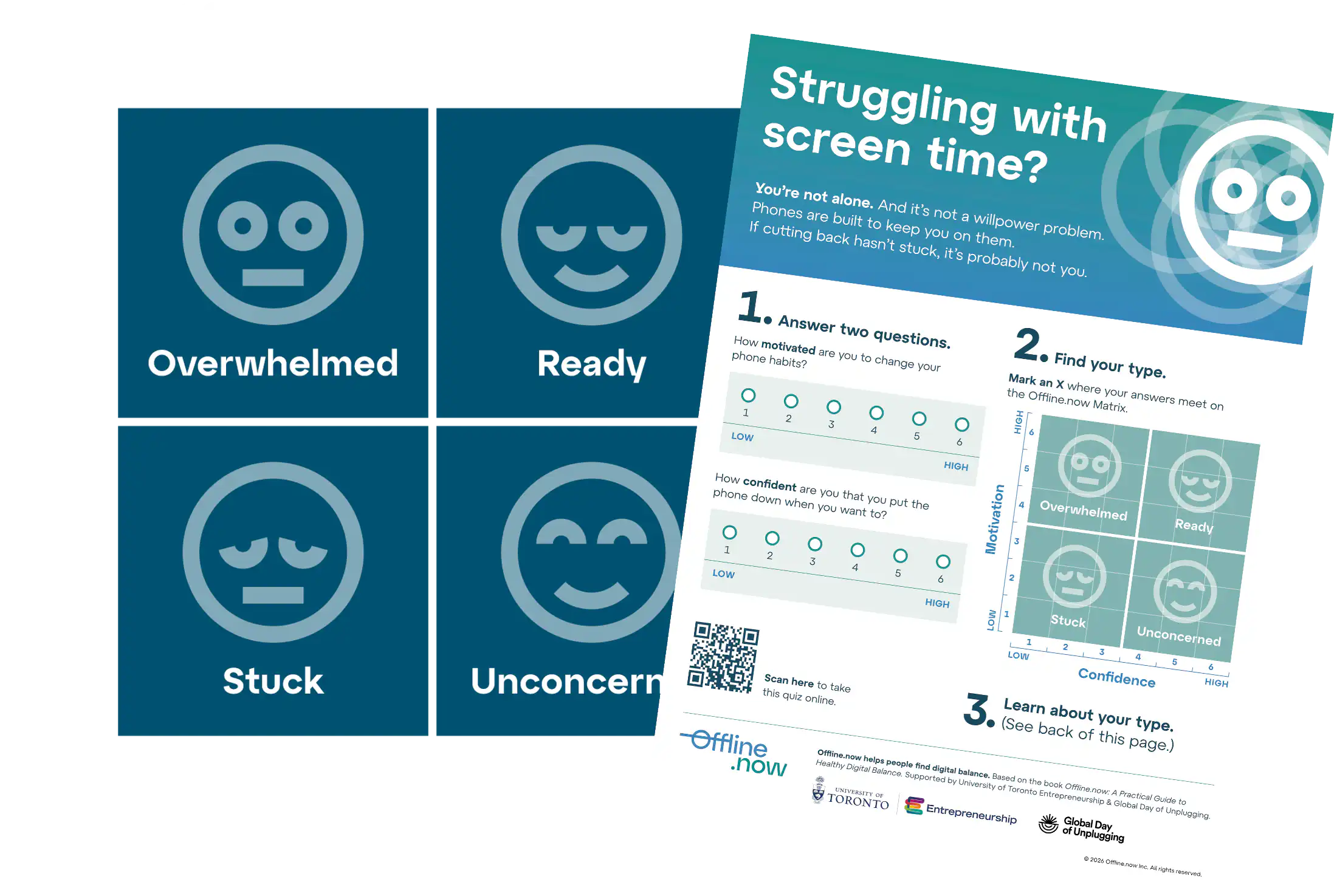
Find your starting place.

Answer 2 questions. Get your type, your first step, and free worksheet.

part of

University of Toronto Entrepreneurship Logo

Canada’s Ambassador for

It was never just a willpower problem.

Most screen advice starts with rules. Offline.now starts with confidence. Find the starting place that fits where you are right now.

Two questions. Four starting places.

The Offline.now Matrix looks at two things: motivation and confidence. Take the quiz online for your personalized result, or use the free worksheet on paper. Either way, you get a starting place and one practical first step.

A community behind the first step

750+ therapists, coaches, counsellors, social workers, and guides are part of the Offline.now network. The Matrix helps you begin. The community helps when the next step gets personal.
Offline.now A Practical Guide to Healthy Digital Balance

Go deeper into the Matrix

The quiz and worksheet help you find your starting place. The book takes you further, with type-specific guidance for changing screen habits in a way that feels practical and doable.

Available at
Available at Amazon

Digital balance is an ongoing conversation

Read stories, ideas, and practical guidance from the Offline.now community.

Nights don’t unravel because you lack discipline, they unravel because your brain hasn’t had a clean transition out of the digital world. When screens stay on until sleep, your nervous system stays on, too. This 15-minute evening reset isn’t about rigid routines or perfection. It’s about creating a gentle boundary between stimulation and rest—so your body can exhale, your mind can settle, and sleep can actually do its job.
If you have ADHD, rest can feel strangely uncomfortable—even guilt-inducing. You may be exhausted, yet unable to stop, reaching for your phone instead of truly recharging. This isn’t laziness; it’s neurobiology. ADHD brains struggle to shift from “go mode” to rest, and digital scrolling often becomes a poor substitute for real recovery. This article reframes rest as a regulation strategy, offering gentle, science-backed recovery rituals for guilt-free downtime.
Mid-January can feel strangely flat once the holiday buzz fades. Motivation dips, scrolling increases, and life can feel muted—not because you’ve failed, but because your brain is recalibrating after a dopamine-rich season. This post explains the January slump through a nervous system lens and offers gentle, sensory resets that support mood and energy without willpower, pressure, or a forced “new year” overhaul.
A few weeks into the new year, motivation often fades and stress quietly takes its place. This post explores why traditional resolutions burn us out, how habit fatigue affects the nervous system, and why it’s not a discipline problem. With research-backed insights and a simple 48-hour reset approach, you’ll learn how to step off the pressure loop, regain clarity, and create sustainable change without forcing a “new you.”
After recovering from paralysis, Amanda Campbell noticed a pattern among burned-out leaders: they’d tried every strategy, yet their bodies still wouldn’t let them rest. This post explains why burnout isn’t a mindset problem, but a somatic one—and how the THRIVE program was designed to rebuild resilience by addressing the nervous system, stored stress, and the physical realities of digital overload, not just productivity habits.
Most New Year resolutions fail because they rely on motivation instead of systems. If you’re tired of the all-or-nothing cycle, there’s a better way. Tiny “If-Then” rules—like plugging in your phone across the room or delaying checks until a set time—turn vague intentions into automatic habits. These micro-steps build confidence, reduce overwhelm, and help you create realistic New Year resolutions that actually last. Change happens when your rules get smaller, not when your goals get bigger.