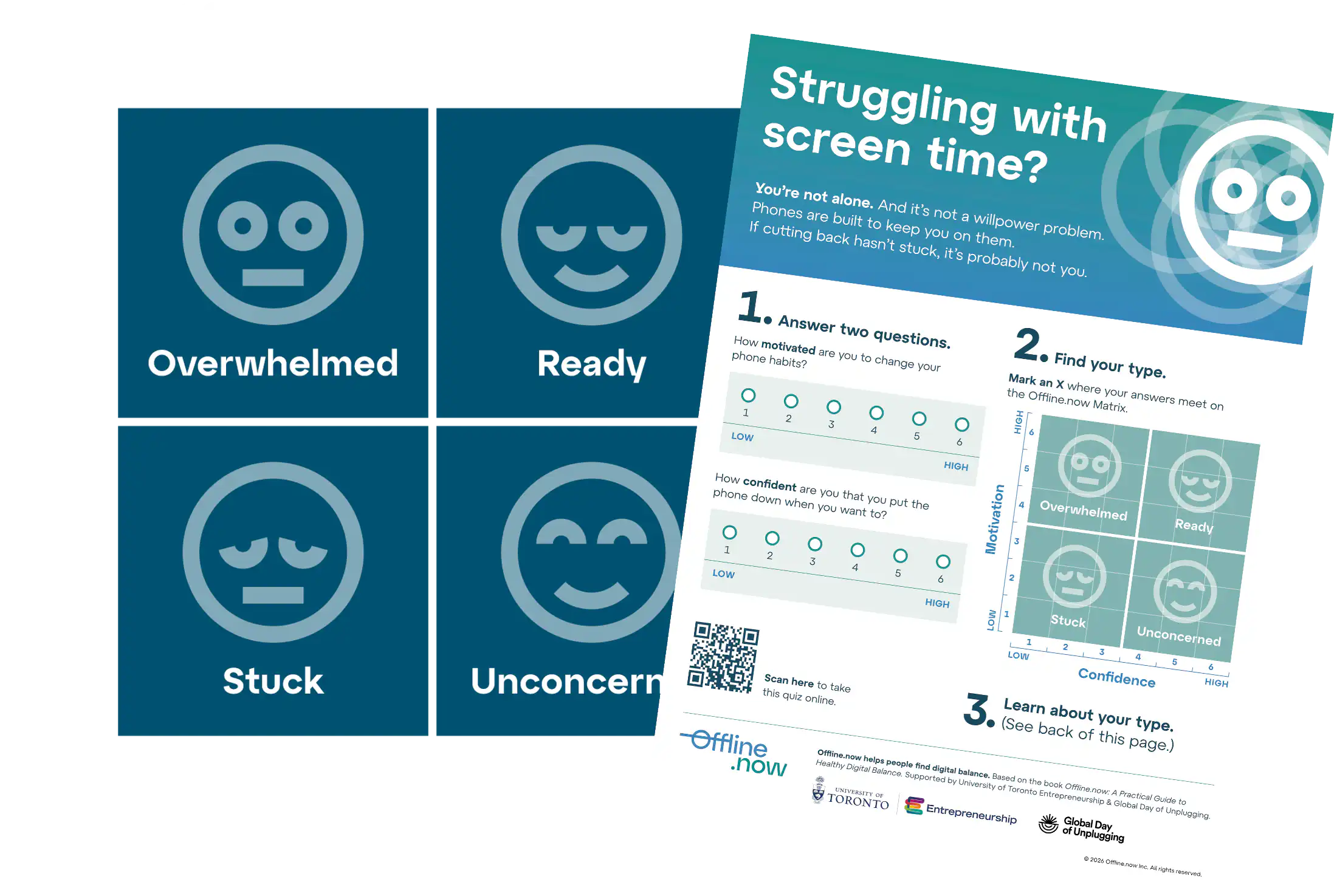
Most screen advice starts with rules. Offline.now starts with confidence. Find the starting place that fits where you are right now.
Two questions. Four starting places.
The Offline.now Matrix looks at two things: motivation and confidence. Take the quiz online for your personalized result, or use the free worksheet on paper. Either way, you get a starting place and one practical first step.
The quiz and worksheet help you find your starting place. The book takes you further, with type-specific guidance for changing screen habits in a way that feels practical and doable.
Midlife divorce carries its own weight. It arrives alongside the emotional reality of starting over at a stage of life many assumed would feel more settled. The shift after divorce is rarely instant, and it should not be sold that way. What women often need first is steadiness. Then comes clarity. Then confidence begins to return on its own terms.
If a pattern can be passed down, it can also be put down. Here's what healing generational trauma actually looks like — naming the pattern, calming the body, rewriting the story, setting boundaries, and grieving what you didn't get — and how to break the cycle without blaming your parents.
Inherited trauma rarely announces itself. It shows up in your body, your relationships, and your habits — wearing the costume of “that's just how I am.” Here's how generational trauma surfaces as hypervigilance, repeating relationship patterns, addiction, control, and people-pleasing, and why recognizing it is the turning point.
“What's your attachment style?” became a third-date question, but the dating-app version gets one thing backwards. Your attachment style isn't a fixed personality trait you were born with — it's a pattern you learned, and often one you inherited. Here's where it really comes from and how it can change.
As an ADHD coach, I see it constantly: attention in ADHD isn't broken, it's interest-based. Screens are simply efficient dopamine delivery, meeting a need that's already there. Here's a clearer way to understand hyperfocus, and how to work with your wiring instead of against it in a world built to capture it.
“Generational trauma” gets thrown around on TikTok for everything, but the real thing is far more useful than the watered-down version. Here's what intergenerational trauma actually is, how it passes between generations, the signs you might be carrying it, and why you can be the one it stops with.
Offline.now helps people change their phone habits without shame.