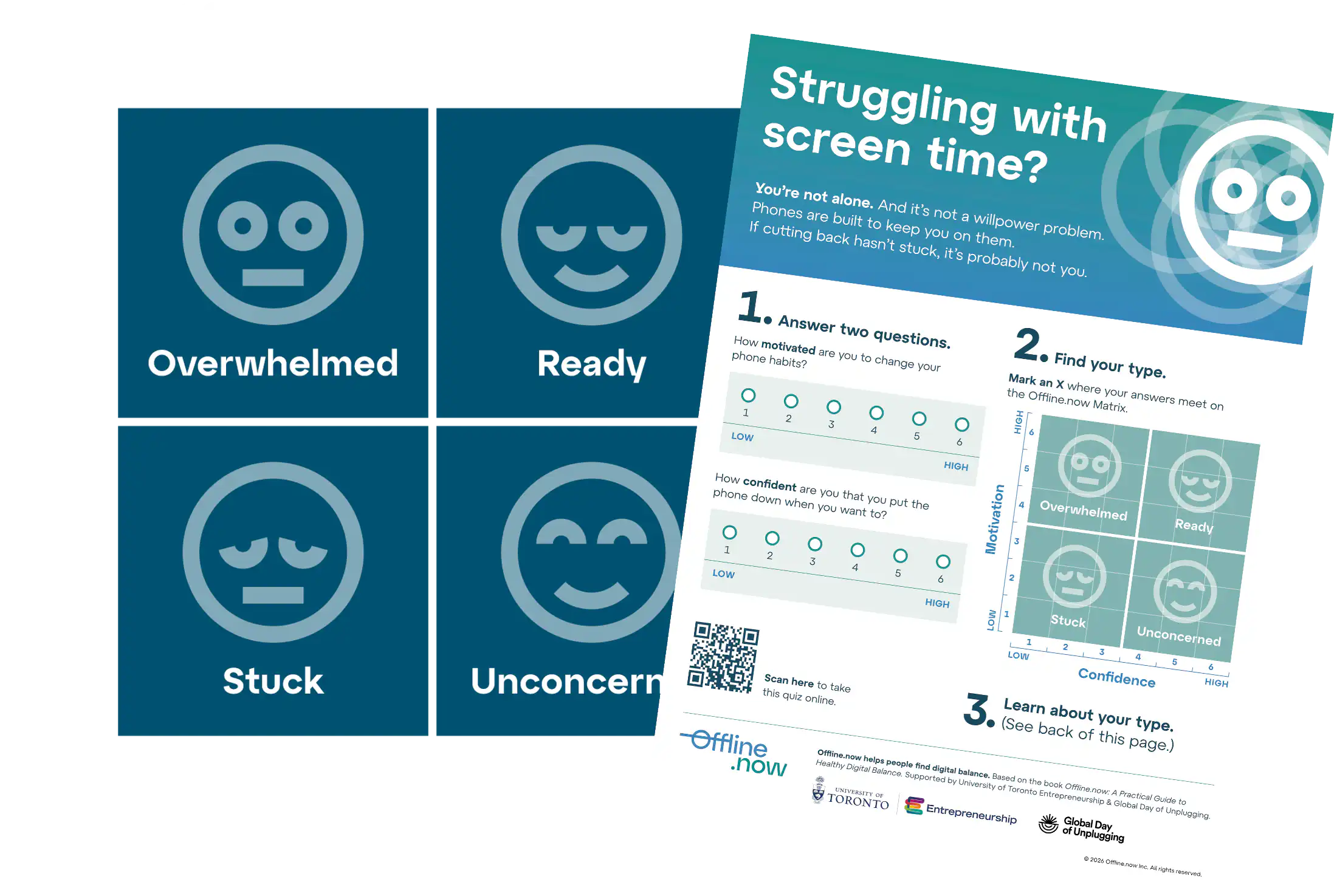
Find your starting place.

Answer 2 questions. Get your type, your first step, and free worksheet.

part of

University of Toronto Entrepreneurship Logo

Canada’s Ambassador for

It was never just a willpower problem.

Most screen advice starts with rules. Offline.now starts with confidence. Find the starting place that fits where you are right now.

Two questions. Four starting places.

The Offline.now Matrix looks at two things: motivation and confidence. Take the quiz online for your personalized result, or use the free worksheet on paper. Either way, you get a starting place and one practical first step.

A community behind the first step

750+ therapists, coaches, counsellors, social workers, and guides are part of the Offline.now network. The Matrix helps you begin. The community helps when the next step gets personal.
Offline.now A Practical Guide to Healthy Digital Balance

Go deeper into the Matrix

The quiz and worksheet help you find your starting place. The book takes you further, with type-specific guidance for changing screen habits in a way that feels practical and doable.

Available at
Available at Amazon

Digital balance is an ongoing conversation

Read stories, ideas, and practical guidance from the Offline.now community.

Feeling anxious about your teen’s screen time? You’re not alone. Many parents struggle with digital parenting stress and constant device tension at home. Research confirms that excessive use affects sleep, mood, and focus—but the solution starts with you. By practicing self-compassion, modeling balanced tech habits, and setting gentle family boundaries, you can shift from control to connection and bring calm back into your home—one screen-free moment at a time.
Tired of chaotic mornings and restless nights? A simple change: moving your phone out of the bedroom can transform your family’s energy and focus. Research shows that blue light and late-night scrolling disrupt sleep and self-control. Creating phone-free mornings builds healthier bedtime boundaries, reduces digital clutter, and helps families reconnect. This small environmental upgrade brings calm, clarity, and presence back to your mornings - no drastic detox required, just a bedside reset that actually works.
We’re public. The Offline.now Digital Wellness Directory is live - and open to listings. No commission. You own the client relationship. SEO-optimized profiles with deep specialties and filters. Therapists, coaches, social workers, addiction specialists, and counsellors: get discovered for what you actually do - ADHD + screens, doomscrolling, family tech conflict, online dating burnout, notification anxiety. Start a 60-day free trial, then $25/mo or $200/yr. Create your profile in minutes; we verify and publish quickly. Join today. Get listed.
Feeling wiped out after endless Zoom calls? You’re not alone. Zoom fatigue is a unique kind of digital exhaustion caused by constant visibility and cognitive overload. The pressure to stay camera-ready blurs work–life boundaries and drains focus. The good news: simple boundaries can help. Learn how camera-optional meetings, focus blocks, and asynchronous tools reduce video call stress, rebuild attention, and make remote work feel human again—without sacrificing connection.
If “just a minute” on your phone turns into forty-five, Offline.now: A Practical Guide to Healthy Digital Balance is for you. Drawing from years spent shaping online communities - and a personal ADHD journey. This book introduces the Offline.now Matrix, a simple self-check to help you start small and stay balanced. With bite-sized chapters, practical steps, and zero guilt, it’s your roadmap to reclaim focus and reconnect with real life, one mindful moment at a time.
Ever feel like your brain is hijacked by endless pings and scrolls? For adults with ADHD, this isn’t a weaknessi. Constant digital distraction cycles are powered by dopamine loops that make apps feel irresistible and leave you battling focus fatigue. Every notification adds a costly task-switch, draining your mental energy. The good news: with small resets like adding friction to apps, naming triggers, and using movement, you can interrupt the loop and reclaim attention.